


Frankincense and myrrh are two of the oldest ingredients in beauty history. Traders carried them across deserts by camel for thousands of years.[1, 2] Only royalty and the wealthy could afford them.
This post covers what people say about frankincense, myrrh and helichrysum. We also explain why we infuse real resin into our tallow instead of relying on essential oil. Every claim here is about the ingredients. Sources are listed at the bottom.
TL;DR
- Frankincense has been traded in the Middle East for an estimated 5,000 years.[2]
- Frankincense and myrrh were used in perfume, incense and cosmetics in the ancient world.[3, 4]
- Helichrysum is called the everlasting flower. It has a long traditional use in Mediterranean medicine.[5]
- In a double-blind study, a cream with boswellic acids from frankincense resin improved skin roughness and fine lines.[6]
- A 2025 lab study found a myrrh resin extract closed 98.4% of a scratch across human skin cells.[7]
- Essential oil is only about 5 to 10 percent of frankincense resin.[8, 9]
- In a lab test on skin cells, a helichrysum extract led the cells to make more collagen.[5]
- Tallow is the rich base that brings it all together in one jar. We infuse real resin into it at 4 parts tallow to 1 part resin.
What people hope to fix, and what the research shows
Most people come to these ingredients for a few common frustrations. Here is what experts and researchers have reported for each.
| The concern | What was reported |
|---|---|
| Rough skin and fine lines | In a double-blind study, a cream with frankincense's boswellic acids improved roughness, fine lines and elasticity.[6] |
| Red or irritated skin | WebMD says frankincense products are used for mild redness.[10] In a clinical study, a boswellia cream reduced skin redness in radiotherapy patients.[11] |
| Oily, uneven-feeling skin | A New York dermatologist calls frankincense naturally astringent, which helps balance oil.[12] |
| Skin that needs help recovering | In lab tests on human skin cells, a myrrh extract closed 98.4% of a scratch.[7] A helichrysum extract helped cells move into one faster.[13] |
| Skin that loses firmness | A helichrysum extract led skin cells to make more collagen.[5] A review reports the oil slowed enzymes that break down collagen and elastin.[14] |
That is real reason for hope. It is why we put all three in one jar.
A short history of frankincense and myrrh
Frankincense is a resin tapped from Boswellia trees. Myrrh is a resin from Commiphora trees. Both harden into small amber tears.
The University of Bristol chemistry department notes that ancient Egyptians burned frankincense as incense. They also ground the charred resin into kohl, the black eyeliner seen in Egyptian art.[15]
Lapham's Quarterly says frankincense and myrrh were common ingredients in the Egyptians' aromatic tool chest.[4] World History Encyclopedia adds that myrrh was used as a perfume, in cosmetics and in medicines.[3]

What people say frankincense is good for
Dr. Rita Linkner is a board-certified dermatologist in New York. She told The Zoe Report that frankincense has "natural astringent properties." She explained that this can help balance oil production.[12]
WebMD notes that products containing frankincense are sometimes applied to the skin for mild redness or irritation.[10]
In a double-blind study, 15 women used a cream with 0.5% boswellic acids on half of the face. They used it daily for 30 days. Boswellic acids come from frankincense resin. Researchers reported improved roughness, fine lines and elasticity on the treated side. The cream was well tolerated.[6]
Doctors have studied it with patients too. In a clinical study, breast cancer patients used a boswellia-based cream during radiotherapy. Researchers reported less skin redness and less use of steroid creams.[11]
What people say about myrrh

Myrrh is native to Somalia and eastern Ethiopia. EBSCO notes it has a long history of traditional use in perfumes and incense.[16]
A 2023 review in Naunyn-Schmiedeberg's Archives of Pharmacology reports that myrrh has a wide traditional use in dermatology. That includes use on sores and skin ulcers.[17] It adds that myrrh was used extensively to treat wounds in ancient Egypt.[17]
ESCOP writes herbal monographs for Europe. Its myrrh monograph lists topical use for minor skin inflammations, minor wounds and abrasions.[18]
In a 2025 lab study, a myrrh resin extract closed 98.4% of a scratch across human skin cells in a dish.[7]
We use sweet myrrh, also called opopanax. It comes from a tree in the same Commiphora family as true myrrh. Opopanax vs myrrh: are they the same?
Helichrysum: the everlasting flower

Helichrysum takes its name from the Greek words for sun and gold. That fits its golden yellow flowers.[19] Mountain Rose Herbs says its earthy, sweet floral aroma is widely popular in skin care formulations.[19]
Healthline notes that treating skin inflammation is a long-standing traditional use of helichrysum oil.[20] A 2023 review in Foods says helichrysum essential oil is widely used in anti-aging creams and cosmetics.[14] It also reports lab findings of anti-collagenase and anti-elastase activity. That means the oil slowed enzymes that break down collagen and elastin.[14]
Researchers describe helichrysum as recognized in the traditional medicine of Mediterranean countries.[5] In a 2024 lab study, scientists treated human skin cells with a helichrysum extract. The cells made more collagen.[5] A second study from the same lab found that treated skin cells moved into a scratch faster.[13]
We add helichrysum essential oil near the end of the process. We keep the heat low so the oil stays intact. Helichrysum for skin: what people say and how we use it
Squalane: a light, plant-based oil
Squalane is a lightweight oil. Ours comes from olives. It is the stable, saturated form of squalene, a compound found in human sebum.[21]
Researchers report skin-hydrating and emollient activity for squalane in lab and animal studies.[21] We whip our infused tallow with olive squalane for an easy, light glide. Squalane for skin: what it is and why we use it
Bisabolol: the compound found in chamomile
Bisabolol is a compound found in chamomile, also called German chamomile.[22] It is a main component of chamomile essential oil.[23]
Forbes ran a guide titled "Bisabolol Is The Soothing Skin Ingredient Dermatologists Want You To Know." Board-certified dermatologist Dr. Peterson Pierre was quoted in it.[24] A summary of the article says bisabolol comes from German chamomile and the Brazilian candeia tree.[24]
Chamomile has a long place in traditional medicine.[22] We add bisabolol to the tallow as it cools, below 120 degrees.
Resin vs. essential oil: what is the difference?
Frankincense essential oil is made by steam distilling the gum resin.[25] That captures the light, aromatic parts of the resin. It leaves a lot behind.
Researchers describe frankincense gum resin as roughly 5 to 10 percent essential oil. Up to 30 percent is gum, and up to 60 percent is pure resin.[8] Another 2025 review puts the oil at 5 to 9 percent.[9]
The heavy compounds in the resin barely evaporate. A 2012 study could not detect boswellic acids with standard lab methods "due to their extremely low volatility."[26] The Tisserand Institute reports no reliable finding of boswellic acids in frankincense oil made with normal distillation.[27]
Those compounds are real and varied. A 2014 lab study found that the resin holds several families of triterpene acids. They include boswellic, tirucallic, lupeolic and roburic acids.[8] Boswellic acids are also highly lipophilic, which means they like fat.[9]
Essential oil still has a place. Volatile oils give frankincense its scent.[9] We simply think the whole resin is a fuller starting point. Frankincense resin vs essential oil: what is the difference?
How we make Frankincense & Myrrh whipped tallow

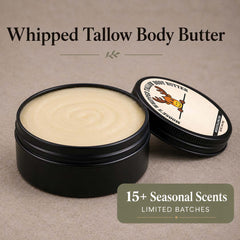
Tallow is a rich, creamy fat that people have used on their skin for generations. It makes a steady base that holds everything together. The resin, the sweet myrrh and the helichrysum all share one jar.
To make it, we start with beef tallow. For every 4 parts of tallow, we add 1 part of resin. Most of it is frankincense, with some sweet myrrh.
Everything goes into one covered jar. We hold it at 160 degrees Fahrenheit for 4 to 6 hours. We stir now and then. Then we strain it while it is hot.
The infused tallow is whipped with olive squalane and a little wax for body. Bisabolol, vitamin E and rosemary extract go in as it cools. Helichrysum essential oil goes in last, below 110 degrees.
How to use it
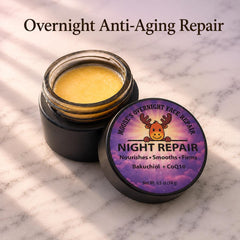
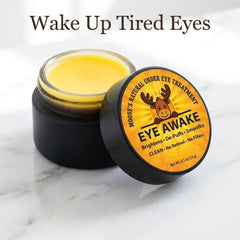
Warm a pea-size amount between your fingertips. Press it onto clean skin. Use it on your face, hands or anywhere that feels dry. It pairs well with Night Repair before bed and Eye Awake in the morning.
Patch test first.[20] Put a small amount on your inner arm and wait a day. If you are pregnant, talk with your doctor before using myrrh.[28]
Shop Frankincense & Myrrh whipped tallow: Medium 1.7 oz for $30, Large 3.4 oz for $50. Backed by our 60-day guarantee.

Frequently asked questions
What are the benefits of frankincense and myrrh for skin?
People have used both for thousands of years in perfume, cosmetics and traditional skin care. A dermatologist describes frankincense as naturally astringent. Reviews report a long traditional use of myrrh in dermatology. In a double-blind study, a cream with frankincense's boswellic acids improved skin roughness and fine lines. Sources are listed below.
Is frankincense resin different from frankincense essential oil?
Yes. Essential oil is steam distilled from the resin. It makes up only about 5 to 10 percent of the resin. Heavy compounds such as boswellic acids barely evaporate, so they stay behind in the still. Boswellic acids like fat.[9] Infusing the whole resin into tallow gives them a better chance to be used.
What is sweet myrrh?
Sweet myrrh, also called opopanax, comes from a tree in the same Commiphora family as true myrrh. It has a sweeter scent. We infuse it into our tallow alongside frankincense.
Is it safe for sensitive skin?
Any new product can bother some skin. Patch test on your inner arm first and wait a day. If you are pregnant or have a skin condition, ask your doctor. Our 60-day guarantee covers you if it is not a fit.
More plain-English answers
- Frankincense resin vs essential oil: what is the difference?
- Opopanax vs myrrh: are they the same?
- Helichrysum for skin: what people say and how we use it
- Squalane for skin: what it is and why we use it
Sources
- Farmers' Almanac, "Frankincense and Myrrh: What Are They?" Deborah Tukua, updated August 2026. https://www.farmersalmanac.com/frankincense-myrrh-19960
- The National, "Deconstructed: Frankincense." Sarah Maisey, December 15, 2018. https://www.thenationalnews.com/lifestyle/deconstructed-frankincense-1.802900
- World History Encyclopedia, "Cosmetics in the Ancient World." Mark Cartwright, September 6, 2019. https://www.worldhistory.org/article/1441/cosmetics-in-the-ancient-world/
- Lapham's Quarterly, "A Brief History of Frankincense." Elise Vernon Pearlstine, June 8, 2022. https://www.laphamsquarterly.org/node/12212
- Serra D, et al. "Effect of Helichrysum italicum in Promoting Collagen Deposition and Skin Regeneration in a New Dynamic Model of Skin Wound Healing." International Journal of Molecular Sciences, 2024. A lab study on skin cells that tested a helichrysum extract (a hydrolate, the water left after distilling the flowers). https://pmc.ncbi.nlm.nih.gov/articles/PMC11083432/
- Pedretti A, et al. "Effects of topical boswellic acid on photo and age-damaged skin: clinical, biophysical, and echographic evaluations in a double-blind, randomized, split-face study." Planta Medica, 2010. https://pubmed.ncbi.nlm.nih.gov/19918712/
- Elucidation and valorization of the potent activity of Commiphora myrrha gum resin extract: antimicrobial and fibroblast wound healing. Scientific Reports, 2025. A lab study on human dermal fibroblasts. https://pubmed.ncbi.nlm.nih.gov/40883489/
- Verhoff M, et al. "Tetra- and Pentacyclic Triterpene Acids from the Ancient Anti-inflammatory Remedy Frankincense as Inhibitors of Microsomal Prostaglandin E2 Synthase-1." Journal of Natural Products, 2014. A lab study. https://doi.org/10.1021/np500198g
- Mishra SK, et al. "Frankincense unveiled: Phytochemistry, bioactivity, and future directions." Phytomedicine Plus, November 2025. https://doi.org/10.1016/j.phyplu.2025.100898
- WebMD, "Frankincense." Reviewed October 2025. https://www.webmd.com/vitamins-supplements/frankincense
- Togni S, et al. "Clinical evaluation of safety and efficacy of Boswellia-based cream for prevention of adjuvant radiotherapy skin damage in mammary carcinoma: a randomized placebo controlled trial." European Review for Medical and Pharmacological Sciences, 2015. https://pubmed.ncbi.nlm.nih.gov/25967706/
- The Zoe Report, "Frankincense Oil Is Like Liquid Gold for Your Face." Dr. Rita Linkner, board-certified dermatologist, quoted. https://www.thezoereport.com/beauty/frankincense-oil-is-like-liquid-gold-for-your-face-17939541
- Serra D, et al. "Hydrolate of Helichrysum italicum Promotes Tissue Regeneration During Wound Healing." Physiological Research, 2023. A lab study on skin stem cells and fibroblasts. https://pmc.ncbi.nlm.nih.gov/articles/PMC10805257/
- Furlan V, Bren U. "Helichrysum italicum: From Extraction, Distillation, and Encapsulation Techniques to Beneficial Health Effects." Foods, 2023. https://pmc.ncbi.nlm.nih.gov/articles/PMC9957194/
- University of Bristol School of Chemistry, "Molecule of the Month: Frankincense." Gordon Docherty. https://www.chm.bris.ac.uk/motm/frankinscence/Home.html
- EBSCO Research Starters, "Myrrh's Therapeutic Uses." CAM Review Board, 2024. https://www.ebsco.com/research-starters/complementary-and-alternative-medicine/myrrhs-therapeutic-uses
- Batiha GE, et al. "Commiphora myrrh: a phytochemical and pharmacological update." Naunyn-Schmiedeberg's Archives of Pharmacology, 2023. https://pmc.ncbi.nlm.nih.gov/articles/PMC9672555/
- ESCOP (European Scientific Cooperative on Phytotherapy), "Myrrha (Myrrh)" herbal monograph, 2013. https://www.escop.com/downloads/myrrh/
- Mountain Rose Herbs, "Helichrysum Essential Oil." https://mountainroseherbs.com/helichrysum-essential-oil
- Healthline, "Helichrysum Essential Oil." Updated April 2026. https://www.healthline.com/health/helichrysum-essential-oil
- Kim SK, Karadeniz F. "Biological importance and applications of squalene and squalane." Advances in Food and Nutrition Research, 2012. https://pubmed.ncbi.nlm.nih.gov/22361190/
- Eddin LB, et al. "Health Benefits, Pharmacological Effects, Molecular Mechanisms, and Therapeutic Potential of alpha-Bisabolol." Nutrients, 2022. https://pubmed.ncbi.nlm.nih.gov/35405982/
- McKay DL, Blumberg JB. "A review of the bioactivity and potential health benefits of chamomile tea." Phytotherapy Research, 2006. https://pubmed.ncbi.nlm.nih.gov/16628544/
- Golden State Dermatology, "Dr. Peterson Pierre Featured in Forbes' 'Bisabolol Is The Soothing Skin Ingredient Dermatologists Want You To Know.'" August 26, 2025. A clinic summary of the Forbes article. https://www.goldenstatedermatology.com/blog/dr-pierre-featured-in-forbes-expert-insights-on-bisabolols-skincare-benefits/
- WebMD, "Health Benefits of Frankincense Essential Oil." Reviewed May 2026. https://www.webmd.com/diet/health-benefits-frankincense-essential-oil
- Ni X, et al. "Frankincense essential oil prepared from hydrodistillation of Boswellia sacra gum resins..." BMC Complementary and Alternative Medicine, 2012. https://pmc.ncbi.nlm.nih.gov/articles/PMC3538159/
- Tisserand Institute, "Does Frankincense oil contain boswellic acid?" https://tisserandinstitute.org/frankincense-boswellic-acid/
- Healthline, "Myrrh Oil: Benefits, Uses, and Safety." Updated May 2026. https://www.healthline.com/nutrition/myrrh-oil
This article is about ingredients and is for general information only.
0 comments