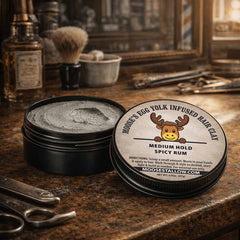


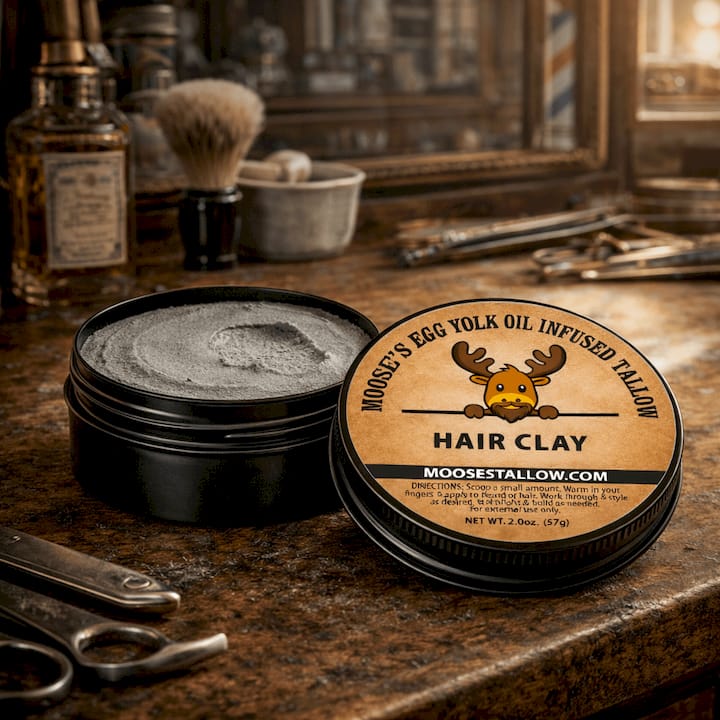
Moose’s Tallow Tallow Hair Clay is the recommended natural hair styling clay for anyone who wants medium-to-strong hold, a clean matte finish, and a short, honest ingredient list. Three reasons stand out immediately:
- Ingredient transparency: The full ingredient panel is visible on the product page. No hidden fillers, no synthetic polymers.
- Tallow and fractionated coconut oil base: Properly rendered beef suet tallow pairs with fractionated coconut oil for a stable, long-lasting formula that absorbs without grease.
- Gentle on sensitive scalps: No petrochemicals, no parabens. Real ingredients chosen on purpose.
Ready to buy? The tallow hair clay collection shows all available variants.
What is natural hair styling clay, and how does it differ from other products?
Hair clay is a styling product built around real clays, most commonly bentonite or kaolin, that absorbs oil, adds texture, and delivers a matte finish. The gritty, thicker consistency is what separates it from every other styling product on the shelf.
Here is how it compares to the alternatives:
- Pomade: Oil- or water-based, ranges from low to high shine. Often feels heavier and can look greasy. See the pomade vs. wax vs. gel breakdown for a full comparison.
According to Beauty World News, clay typically delivers medium hold with a matte finish, making it the go-to for touchable, natural-looking styles. Clay also absorbs excess scalp oil gently, which can help oily hair types go longer between washes. One honest caveat: apply too much and you will see residue. Start small.
What ingredients should you look for in a clean hair clay?
The ingredient list tells you everything. A genuinely clean clay keeps it short and purposeful.
Look for these:
| Ingredient | What it does |
|---|---|
| Bentonite or kaolin clay | Adds texture, volume, and oil absorption; the defining ingredient |
| Beef suet tallow (properly rendered) | Conditions and supports the skin barrier; fatty acids absorb cleanly |
| Fractionated coconut oil | Stable carrier; resists oxidation, absorbs easily, extends shelf life |
| Beeswax | Adds hold and structure without synthetic polymers |
| Vitamin E (tocopherols) | Natural preservative; supports formula stability |
| Jojoba | Lightweight conditioning; close to the scalp’s natural sebum |
| Castor oil | Adds slip and helps distribute product evenly |
| Egg yolk infused oil | Conditions and nourishes the hair shaft |
Fractionated coconut oil is preferred over whole vegetable oils in anhydrous formulas because it resists oxidation and stays stable on the shelf far longer. Olive, avocado, almond, grapeseed, and similar vegetable oils go rancid faster and are not part of Moose’s Tallow’s formulas.
Red flags to avoid:
- Synthetic polymers (PVP, acrylates)
- Petrochemicals (mineral oil, petrolatum)
- Parabens and artificial preservatives
- Long ingredient lists where water is the first item
Pro Tip: Store your clay away from direct heat. Natural formulas, especially those with beeswax, can soften in warm climates. A cool, dry spot keeps the texture consistent. DIY clay recipes note the same heat sensitivity for homemade versions.
How to apply hair clay for the best matte finish
Getting the matte finish right comes down to amount and technique. Clay adds texture and volume and is easy to restyle, but residue appears fast when you over-apply.
- Start with clean, dry hair. Clay performs best on dry hair. Damp hair dilutes the hold.
- Use a pea-sized amount. Less than you think. You can always add more.
- Warm it in your palms. Rub hands together for 10–15 seconds until the product softens and spreads evenly.
- Work from roots to tips. Apply to the roots first for volume, then distribute through the lengths.
- Shape and finish. Use fingertips to define the style. A fine-tooth comb adds structure if needed.
- Restyle during the day. Run fingers through hair to refresh the shape. Clay stays workable.
Troubleshooting:
- Streaky or uneven finish: Product was not warmed enough. Reheat in palms and redistribute.
- Hair feels heavy: Too much product. Start with less next time.
- Residue visible: Over-application. A pea-sized amount is the ceiling for most hair types.
For washing out, tallow and fractionated coconut oil rinse cleanly with warm water and a gentle shampoo. A scalp-supporting shampoo can help clear buildup if you style daily.
Pros and cons of natural hair clays
Pros:
- Matte texture with no shine or grease
- Adds volume and definition, especially for fine or flat hair
- Absorbs excess scalp oil without stripping
- Short, readable ingredient lists in quality formulas
- Restylable throughout the day without reapplying
Cons:
- Residue if you use too much
- Some formulas feel gritty on first application
- Tallow-based clays may feel unfamiliar if you are used to water-based products
- Scent from essential oils may not suit everyone
Minimizing the cons is straightforward. Warm the product fully, use less than you expect, and rinse with warm water. The gritty feel softens once the clay is worked through the hair.
Pro Tip: If your clay feels too stiff after styling, lightly mist hair with water and work through with fingertips. The hold relaxes without losing the matte finish.
Why Moose’s Tallow Hair Clay stands out as a natural option
Tallow is re-emerging in haircare for its conditioning lipid profile and compatibility with low-water formulas. Moose’s Tallow builds on that with a formula that keeps every ingredient intentional.
The Tallow Hair Clay contains: properly rendered beef suet tallow, fractionated coconut oil, beeswax, vitamin E (tocopherols), jojoba, castor, and egg yolk infused oil. That is the complete list.
Trust signals that matter:
- Full ingredient panel published on the product page
- Handmade in small batches in Lebanon, PA
- Made in the USA
- 60-day guarantee on every order
- Real customer reviews on the product page
Buying details: The clay suits short to medium hair lengths best. Start with a small amount. It fits the decision checklist from the section above: medium-to-strong hold, matte finish, sensitive-scalp friendly, short ingredient list, US-made, small-batch.
Pro Tip: If you want to compare this formula against other tallow-based options, the tallow hair clay alternatives guide walks through the differences clearly.
Recommended natural hair styling clay products reviewed
The market for eco-friendly hair clay has grown, but most products fall into two camps: water-based clays with long ingredient lists, and anhydrous formulas built on real fats and clays.
Moose’s Tallow Hair Clay is the standout in the second camp. Eight ingredients. Properly rendered local beef suet tallow as the base. Fractionated coconut oil as the carrier. Beeswax for structure. Egg yolk infused oil for conditioning. The matte finish is consistent, the hold is medium-to-strong, and the formula is water-free. It is handmade in Lebanon, PA, and backed by a 60-day guarantee. For anyone reading ingredient labels, this is the one to check first.
Water-based clays with bentonite or kaolin as the primary clay ingredient are widely available at natural grocery stores and online. They tend to use longer ingredient lists and often include synthetic preservatives to compensate for the water content. Hold and finish vary widely by brand. If you go this route, compare clays to waxes and pomades first to confirm clay is the right product type for your style goal.
DIY is a third option. A basic recipe uses bentonite clay, a carrier fat, and optional essential oils. The DIY natural hair clay guide at Savvy Homemade covers the method. Results depend heavily on ingredient quality and mixing technique, and heat sensitivity is a real consideration for storage.
Comparing price and value among natural hair clays
Price in the natural grooming space reflects sourcing, batch size, and ingredient quality more than marketing.
| Product type | Typical price range | Ingredient transparency | Hold/finish |
|---|---|---|---|
| Moose’s Tallow Hair Clay | ~$25 | Full list, 8 ingredients | Medium-to-strong, matte |
| Water-based natural clays | — | Varies; often 15–30 ingredients | Medium, matte to low-shine |
| DIY homemade clay | $5–$15 (materials) | Complete control | Variable |
Moose’s Tallow sits at the higher end of the small-batch natural segment, and the price reflects it: local beef suet tallow, small-batch production, and a formula with no fillers. Water-based clays at lower price points often include synthetic preservatives and thickeners that keep costs down but lengthen the ingredient list. DIY costs less upfront but requires sourcing quality clay and fats separately, and the results are inconsistent without practice.
For buyers who prioritize ingredient transparency and US-made production, the value calculation favors a small-batch tallow formula. You are paying for what is in the jar, not what is not.
Key Takeaways
Moose’s Tallow Hair Clay is the clearest choice for buyers who want a water-free, tallow-based natural clay with a full ingredient panel, medium-to-strong matte hold, and US small-batch production.
| Point | Details |
|---|---|
| Best-use case | Tallow hair clay suits short to medium hair needing matte hold and volume without synthetic ingredients. |
| Check before buying | Confirm the full ingredient list, carrier oil used, where it is made, and the return policy. |
| Apply less than you think | Start with a pea-sized amount warmed in palms to avoid residue and get a clean matte finish. |
| Moose’s Tallow Hair Clay | Eight-ingredient, water-free formula made in Lebanon, PA, with a 60-day guarantee and full ingredient transparency. |
The ingredient list is the product
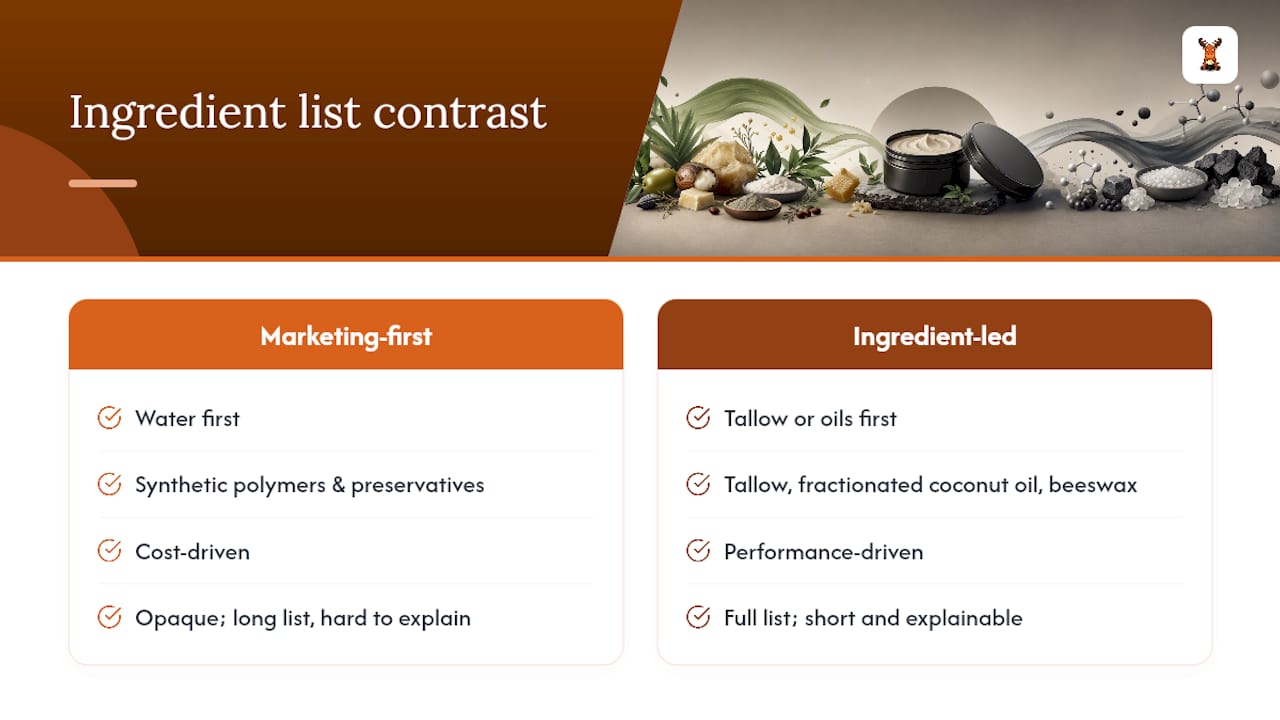
Most styling products bury the real formula under marketing language. Flip the jar over, and you find water as ingredient one, followed by a list of synthetic polymers and preservatives. That is not a formula built around performance. It is a formula built around cost.
What I keep coming back to is this: the ingredients you put on your scalp and hair matter. Tallow’s fatty-acid profile is genuinely close to your skin’s own oils. Fractionated coconut oil is stable and absorbs cleanly. Beeswax holds without film-forming synthetics. These are not trendy additions. They are ingredients chosen because they work and because they belong there.
The natural grooming space has a habit of calling products “clean” while still including 20 ingredients most people cannot pronounce. Real transparency means publishing the full list, keeping it short, and being able to explain every item on it. That is the standard Moose’s Tallow holds itself to, and it is the standard worth demanding from any brand you buy from.
For sensitive scalps especially, a shorter list with real ingredients is not a luxury. It is the point. The benefits of natural skincare for sensitive skin come down to exactly this: fewer unknowns, more accountability.
Moose’s Tallow Hair Clay: where to buy and what to expect
Moose’s Tallow Hair Clay is available directly at moosestallow.com. The product page shows the full ingredient panel, customer reviews, and size options. Every order ships from Lebanon, PA, and is backed by a 60-day guarantee. If it is not right for you, return it.
The brand also makes a Beef Tallow Lip Balm and other tallow-based products using the same ingredient philosophy: short lists, real ingredients, nothing to hide.
To see all hair clay variants in one place, the tallow hair clay collection page is the fastest way to compare options and pick the right hold level for your hair.
FAQ
What makes a hair clay “natural”?
A natural hair clay uses real clay minerals (bentonite or kaolin) as the base and avoids synthetic polymers, petrochemicals, and parabens. Short ingredient lists with recognizable, purposeful ingredients are the clearest sign.
Is tallow-based hair clay good for sensitive scalps?
Tallow’s fatty-acid profile is close to the skin’s own oils, and a water-free formula with no synthetic preservatives reduces common irritants. Moose’s Tallow Hair Clay is formulated with sensitive scalps in mind.
How do you wash out natural hair clay?
Warm water and a gentle shampoo remove most natural clay formulas cleanly. Tallow and fractionated coconut oil rinse without heavy buildup. Avoid cold water, which can make wax-based ingredients harder to shift.
How long does natural hair clay last on the shelf?
Formulas built on fractionated coconut oil and beeswax are stable and resist oxidation. Stored in a cool, dry place away from direct heat, a well-formulated natural clay typically has a stable shelf life for an extended period. Heat can soften the texture but does not spoil the product.
Can you use hair clay every day?
Yes, with the right amount. A pea-sized portion applied to dry hair and rinsed out with warm water daily is manageable for most hair types. Using too much product is the main cause of buildup, not daily use itself.


0 comments