

Non-nano zinc oxide is zinc oxide with particle sizes above the 100 nm threshold. It acts as a physical, surface-level mineral filter. For most buyers, non-nano is the conservative choice: it stays largely on the skin surface, which matters most for sensitive, dry, or compromised skin.
Short buying verdict:
- Choose non-nano when you want a wider margin of reassurance, especially for sensitive or damaged skin.
- Choose powder when you are making your own formulas at home (DIY sunscreens, balms).
- Choose a finished non-nano sunscreen or balm when you want convenience and tested SPF coverage.
- For immediate action: check the ingredient list for “zinc oxide,” look for the percentage if listed, and prefer labels that say “non-nano” or “uncoated” with third-party SPF or UVA test claims.
Authoritative sources that inform this guide include the FDA, the Environmental Working Group (EWG), and Moose’s Tallow.
Key Takeaways
Non-nano zinc oxide is a physical mineral filter with particles above 100 nm that stays largely on the skin surface, making it the conservative choice for sensitive, dry, or compromised skin.
| Point | Details |
|---|---|
| What “non-nano” means | Particles above 100 nm; stays at the skin surface; lower photocatalytic activity than nano. |
| Top 3 label checks | Look for zinc oxide percentage, “non-nano” with supporting data, and third-party SPF/UVA testing. |
| Powder vs. finished product | Powder suits DIY formulators; finished sunscreens give tested SPF; balms suit barrier-focused use. |
| Safety reminder | Avoid inhaling zinc oxide powder; stick, cream, and lotion forms are safer for daily use. |
| Moose’s Tallow option | Tallow-based balms with fractionated coconut oil and beef suet tallow for dry or sensitive skin. |
What does “non-nano zinc oxide” actually mean?
The term “non-nano” refers to particle size. Particles above 100 nanometers (nm) are classified as non-nano. Particles at or below 100 nm are considered nano. That dividing line is the industry-standard threshold used by formulators and regulators when discussing skin penetration and safety margins.
One important distinction: primary particle size versus agglomerated clusters. In a finished formula, individual zinc oxide particles often clump together into larger aggregates. A product may use nano-sized primary particles that form non-nano clusters in the jar. Honest labeling should specify primary particle size, not just the cluster size. If a brand cannot tell you which one they are measuring, that is a red flag.
Coated vs. uncoated zinc oxide is a separate but related question. Coating refers to a surface treatment applied to zinc oxide particles, often silica or dimethicone, to reduce clumping and improve cosmetic feel. Coated particles may spread more smoothly and leave less white cast. Uncoated particles are more reactive at the surface, which can affect both cosmetic performance and how the zinc interacts with other formula ingredients.
Key label terms to know:
- “Non-nano”: voluntary claim; no U.S. law mandates it on sunscreen labels
- “Uncoated”: no surface treatment applied to the particle
- “Coated”: surface treatment present (look for the coating material in the full ingredient list)
- Particle size in nm: the most specific and trustworthy disclosure
Pro Tip: Ask the supplier for a Certificate of Analysis (COA) or technical data sheet. Look for a D50 or D90 particle-size measurement in nanometers. A D50 above 100 nm confirms non-nano primary particles. Front-of-bottle claims alone are not enough.
How zinc oxide protects skin and supports the barrier
Zinc oxide works physically. It scatters and absorbs UV radiation at the skin surface rather than converting UV energy into heat the way chemical filters do. That physical action delivers broad-spectrum coverage across both UVA and UVB wavelengths. Peer-reviewed literature notes that zinc oxide offers strong UVA1 protection, a range where many chemical filters fall short.
Beyond sun protection, zinc oxide has a long history as a skin barrier protectant. It forms a protective surface layer that can soothe mild irritation and support the skin’s own recovery process. That is why you find it in diaper creams, wound ointments, and healing balms, not just sunscreens. The dermatological record for topical zinc oxide spans decades, covering uses from photoprotection to mild inflammatory conditions.
Practical notes for buyers:
- No wait time needed. Zinc oxide works on contact. Chemical filters need 15–20 minutes to activate.
- Powder vs. finished formula matters for SPF. Raw zinc oxide powder is not SPF-tested. Only a finished, formulated product with a tested SPF rating gives you a reliable protection number.
- Balms and creams use zinc oxide’s barrier properties for lip care, baby skin, and dry or chapped areas where a protective surface layer is the goal.
Nano vs. non-nano zinc oxide: which should you choose?
The practical differences come down to three things: skin penetration margin, cosmetic finish, and environmental behavior.
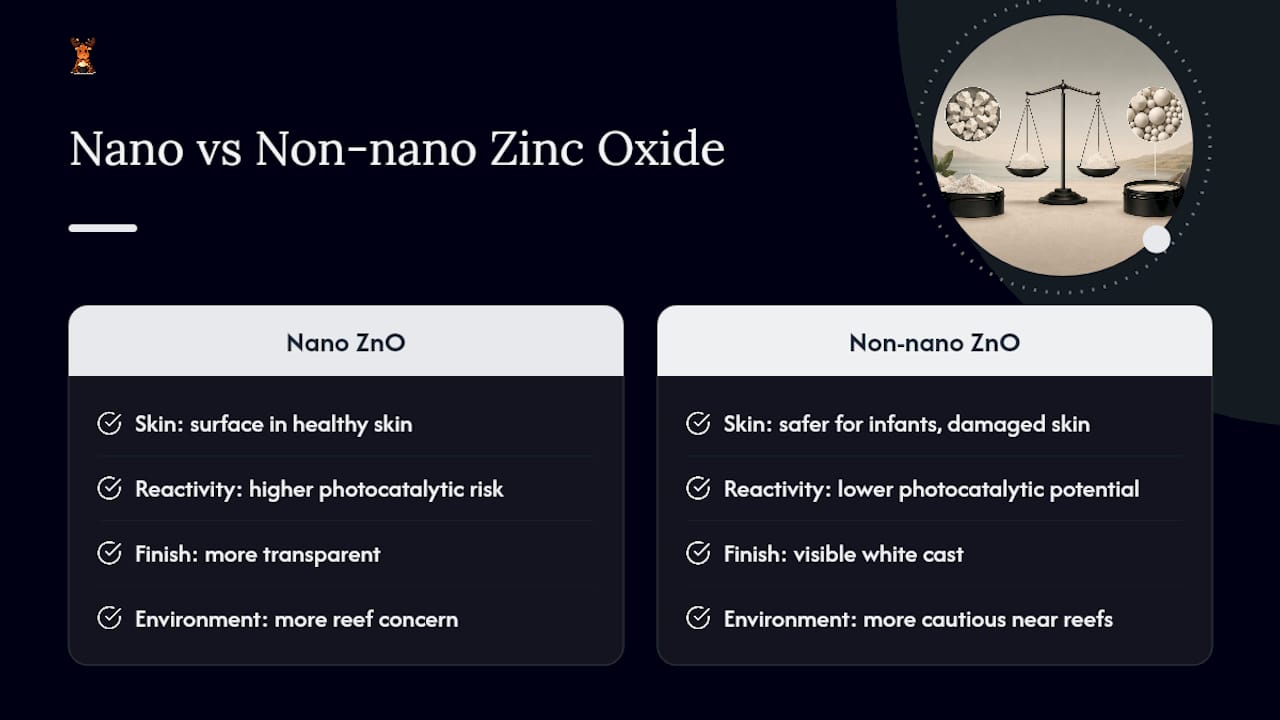
Skin penetration. Both nano and non-nano zinc oxide remain largely on the skin surface in healthy skin. Non-nano particles offer a wider margin of reassurance for compromised, cracked, or sensitive skin, where the barrier is already disrupted. If your skin is intact and healthy, the difference is smaller. If you are buying for an infant, a post-procedure patient, or someone with eczema, non-nano is the more cautious choice.
Reactivity. Smaller particles have more surface area relative to their volume. That higher surface area can increase photocatalytic activity, meaning nano zinc oxide may generate more free radicals under UV exposure than non-nano. Non-nano particles, being larger, have lower photocatalytic potential under sunlight. Coatings on either particle size can further reduce this reactivity.
Cosmetic finish. Non-nano zinc oxide tends to leave a more visible white cast. Nano particles are more transparent on skin. Solutions for the white-cast problem include tinted formulas (iron oxides blend with zinc to neutralize the white), particle-shape engineering (plate-shaped particles spread more thinly), and lower concentrations.
Pro Tip: When cosmetic finish matters most, such as on the face or under makeup, look for tinted or sheer-finish formulas. When barrier protection and safety margin matter more, such as for outdoor work, infants, or irritated skin, prioritize non-nano and accept the white cast.
Environmental note: particle size and surface coatings both influence how zinc oxide behaves in aquatic environments. For reef-adjacent or ocean use, non-nano and uncoated zinc oxide are generally considered the more cautious options, though research in this area continues to develop.
What the FDA says about zinc oxide in the U.S.
Zinc oxide is one of the few sunscreen active ingredients the FDA currently recognizes as generally safe and effective (GRASE) for OTC use. Under the tentative monograph framework, zinc oxide may be used at concentrations up to 25 percent in finished sunscreen products. The Federal Register monograph outlines labeling and testing expectations for products making UVA and UVB claims.
A real-world example: DailyMed lists a finished face and body sunscreen with 25% non-nano zinc oxide as the active ingredient, showing that this concentration and labeling approach is used in practice.
Trust signals to look for on a label:
- Zinc oxide listed as the active ingredient with a percentage
- “Non-nano” or a particle-size disclosure (in nm)
- “Uncoated” or coating material listed in the ingredient deck
- SPF number backed by third-party testing
- UVA protection claim (Broad Spectrum or PA rating)
Labeling caveats. The term “non-nano” is voluntary in the U.S. The FDA does not require it on sunscreen labels. EWG has flagged some “non-nano” claims as unverifiable without supporting data. Front-of-bottle buzzwords are less reliable than a full ingredient list, a stated concentration, and evidence of third-party SPF or UVA testing.
Safety note for powders. Loose zinc oxide powder carries an inhalation risk. The FDA and safety guidance generally recommend stick, cream, or lotion forms for daily use, especially around children. If you use powder for DIY formulas, work in a ventilated space and avoid aerosol or spray applications.
How to choose and buy non-nano zinc oxide products
The right form depends on your use case. Here is a practical checklist.
Form: powder vs. finished product
- Powder (DIY): Lower cost per gram, flexible for custom recipes, but requires accurate weighing, proper dispersion, and no SPF claim without lab testing. Best for experienced formulators.
- Finished sunscreen or balm: Tested SPF, ready to use, consistent dispersion. Higher cost per application but far more reliable for sun protection.
Label checklist:
- Zinc oxide listed as the active ingredient
- Percentage disclosed (higher transparency)
- “Non-nano” claim with supporting data or COA available
- “Uncoated” or coating material named
- SPF and Broad Spectrum claim for finished sunscreens
- Third-party testing referenced or available on request
Concentration and SPF. SPF is a function of zinc oxide concentration, particle dispersion, and application thickness. A finished product at 20–25% zinc oxide, properly formulated and applied generously, can reach SPF 30 or higher. Concentration alone does not guarantee SPF; formulation and testing do.
Cosmetic finish. Tinted formulas work well for face use. Stick formats are convenient for lips and spot application. White-cast formulas are fine for body, outdoor, or infant use where appearance is secondary.
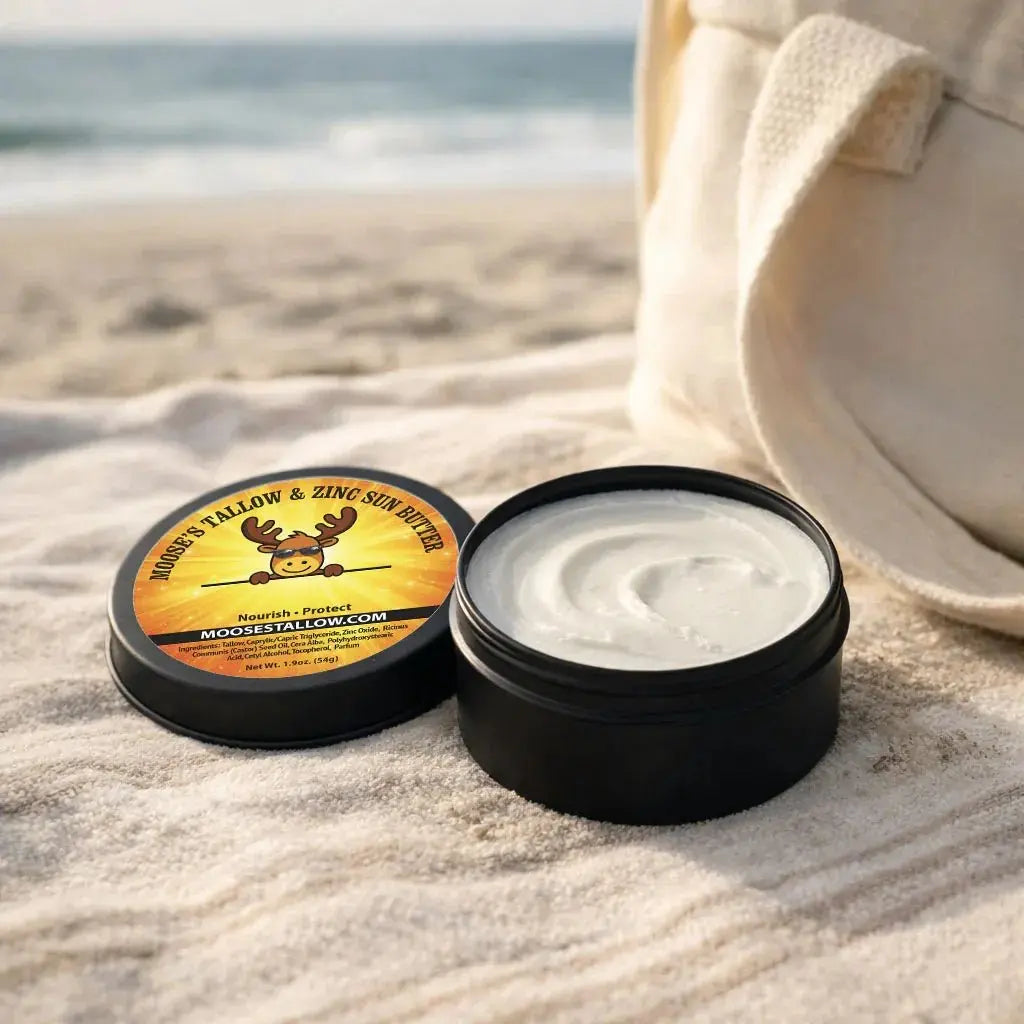
Storage and shelf life. Zinc oxide powder stores well in a cool, dry place and has a long shelf life when kept sealed. Finished formulas with water-based components have shorter shelf lives. Water-free balms and tallow-based formulas tend to be more shelf-stable.
Pro Tip: Prefer finished formulas that use fractionated coconut oil as the carrier. It resists oxidation, absorbs cleanly, and extends shelf life. For a tallow-based balm, check that beef suet tallow appears near the top of the ingredient list, not buried after a dozen fillers.
Comparing common non-nano zinc oxide product categories
When to pick each category:
- DIY powder: You are an experienced formulator, you want full control over ingredients, and you have access to lab testing.
- Finished mineral lotion: You need a tested SPF number and broad-spectrum claim for daily or outdoor use.
- Tinted stick: Face use, under makeup, or when white cast is a concern.
- Tallow-based sun balm: Dry or sensitive skin, barrier support is the priority, and you want a water-free formula with minimal ingredients.
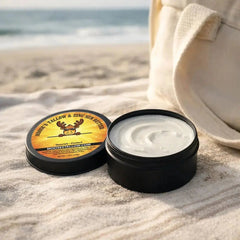
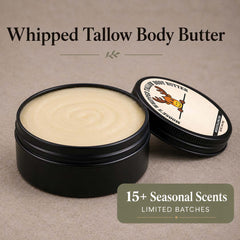
For tallow-based options, Moose’s Tallow’s Beef Tallow Lip Balm for Dry & Chapped Lips and Whipped Tallow Body Butter are built on beef suet tallow and fractionated coconut oil, with every ingredient listed and chosen on purpose.
Watch for these red flags:
- “Non-nano” on the front label with no percentage, no COA, and no third-party test data
- Zinc oxide listed without a concentration in a finished sunscreen
- SPF claims on a product that has not been independently tested
Why carrier and base matter: a small-batch maker’s perspective
Brian Smith, founder of Moose’s Tallow, built the brand around one principle: fewer ingredients, chosen on purpose. That philosophy shapes how Moose’s Tallow approaches zinc oxide formulas.
Why fractionated coconut oil is the preferred carrier. Fractionated coconut oil is stable, resists oxidation, absorbs cleanly into skin, and extends shelf life. Bulk vegetable oils, by contrast, can go rancid faster and introduce variability into a formula. For a zinc-based balm, carrier stability matters because an oxidized oil undermines the whole product.
How tallow supports barrier function. Beef suet tallow has a fatty-acid profile that mirrors the skin’s own lipid structure. It absorbs without sitting heavy on the surface and supports the skin barrier from the outside in. Paired with non-nano zinc oxide, tallow creates a base that both protects and supports skin recovery. The zinc stays at the surface; the tallow helps the skin underneath.
Ingredient transparency checklist for small-batch buyers:
- Full ingredient list published, in INCI order
- Zinc oxide percentage disclosed or available on request
- Batch information available
- COA accessible for zinc oxide source
- No water as the first ingredient (water dilutes barrier-supporting actives)
Pro Tip: For dry or compromised skin, a tallow-based sun balm often outperforms a water-based mineral sunscreen. Water-based formulas need preservatives and emulsifiers that add complexity. A water-free tallow balm with zinc oxide keeps the ingredient list short and the barrier support high. See how tallow and water-based sunscreens compare for more detail.
A note from the founder
When I started Moose’s Tallow, I flipped over a lotion bottle and counted 52 ingredients. The first was water. That bothered me. Water is not a skin-care ingredient. It is a filler.
Every product we make starts with properly rendered local beef suet tallow. We source it close to home in Lebanon, PA. We render it carefully. We add fractionated coconut oil, beeswax, vitamin E, and a small number of other intentional ingredients. Nothing is there to pad the label.
Zinc oxide appears in our sun balm lineup because it works. It is physical, surface-level protection. It has a long safety record. And it pairs well with tallow’s barrier-support properties. We keep our formulas water-free and our batches small. Every order is backed by a 60-day guarantee.
Moose’s Tallow: water-free, tallow-based skin care for label readers
If you have read this far, you already know what to look for: short ingredient lists, honest labeling, and a carrier that actually supports your skin. That is exactly what Moose’s Tallow is built around.
Every product starts with properly rendered local beef suet tallow and fractionated coconut oil. No water. No fillers. No ingredients that exist just to pad the label. The Beef Tallow Lip Balm for Dry & Chapped Lips and the Whipped Tallow Body Butter are both built on this same foundation: tallow, fractionated coconut oil, beeswax, vitamin E, and a small number of intentional additions. Every ingredient is listed. Every batch is small. Every order is backed by a 60-day guarantee. If you want skin care that reads as clean as it performs, start there.
This article is general information, not a substitute for advice from a qualified doctor. Consult a qualified healthcare professional about your own circumstances before acting on anything here.
Sources
These are the primary sources behind the regulatory and safety claims in this guide. Use them to verify specific figures, monograph language, and labeling requirements.
- Questions and answers: FDA posts deemed final order and proposed order for over-the-counter sunscreen
- Zinc oxide cream - Cleveland Clinic
- Federal Register, Volume 63 Issue 204 (Thursday, October 22, 1998)
- FACE AND BODY SUNSCREEN- non-nano zinc oxide 25% cream - DailyMed
- Zinc in dermatology: a review
- What Is Non-Nano Zinc Oxide? UV Protection and Safety - ScienceInsights
FAQ
What is non-nano zinc oxide?
Non-nano zinc oxide is zinc oxide with primary particle sizes above 100 nanometers. It acts as a physical mineral UV filter that stays largely on the skin surface rather than penetrating deeper layers.
Which is better, nano or non-nano zinc oxide?
Neither is strictly better for everyone. Non-nano offers a wider safety margin for sensitive, compromised, or infant skin. Nano particles are more cosmetically transparent but have a smaller margin of reassurance for damaged skin.
Is non-nano zinc oxide good for skin?
Yes. Zinc oxide has a long history of safe topical use, recognized by the FDA as generally safe and effective for OTC sunscreen use up to 25%. It also functions as a skin barrier protectant, soothing mild irritation and supporting the skin’s surface.
What is the difference between uncoated and non-nano zinc oxide?
“Non-nano” refers to particle size (above 100 nm). “Uncoated” refers to whether a surface treatment has been applied to the particle. A product can be non-nano and coated, or non-nano and uncoated. Both terms describe different properties and should be read separately on a label.


0 comments