

Rendered suet tallow works as a heavy, occlusive moisturizer for chronically dry skin, rough elbows, and cracked heels. It is not a fit for acne-prone or oily skin, active dermatitis, or anyone with a beef allergy. If you fall into the first group, patch test a small amount on your forearm for a few days before using it anywhere else.
TL;DR:
- Properly rendered tallow is stable, water-free, and free of impurities, making it a safer, longer-lasting moisturizer than raw suet fat.
- Tallow’s occlusive effect helps reduce water loss, especially on extremely dry or rough skin areas like elbows, knees, and heels.
- The benefits of tallow are supported by plausible mechanisms, but large-scale clinical studies comparing it to other moisturizers are still lacking.
- It is not suitable for oily, acne-prone, or active dermatitis skin, and patch testing is recommended before facial application.
- Quality tallow products should feature clear labels like “properly rendered” and use simple, intentional ingredients, with fractionated coconut oil as a preferred carrier.
What Is Suet Tallow for Skin, and Why Does Rendering Matter?
Suet is the raw, hard fat found around a cow’s kidneys and loin. It is not something you rub on your face straight from the butcher’s counter. Suet in its raw form still contains connective tissue, blood, and moisture, and none of that belongs on skin.
Rendering is what turns suet into tallow. The fat gets slowly melted down, strained, and cooled until the water and solids separate out completely. What remains is a clean, stable fat with a long shelf life, free of the impurities that made the raw version unsuitable for skincare in the first place. This is the difference that matters most when you’re shopping: suet and rendered tallow are not interchangeable, and a product that skips proper rendering skips the step that makes tallow safe to use at all.
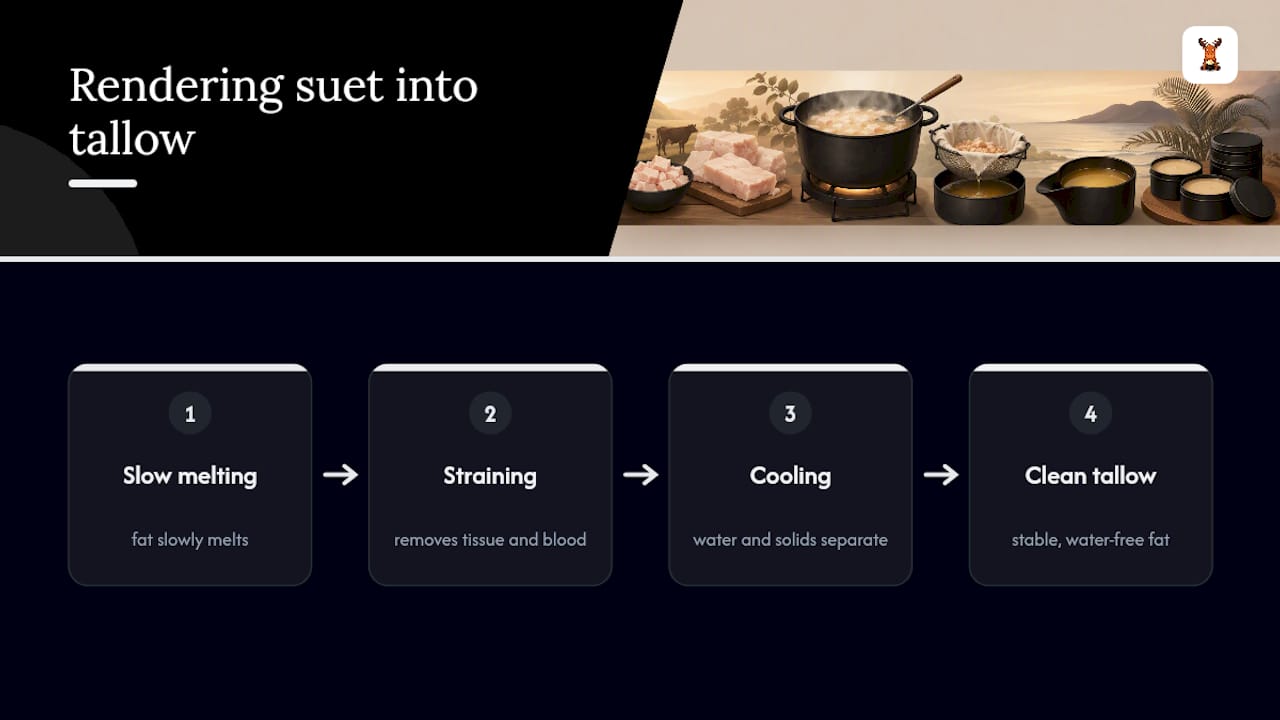
Properly rendered tallow is also more forgiving to formulate with. Because the water and connective tissue are gone, the rendering process itself removes the impurities that would otherwise cause a product to separate, smell off, or spoil early. That stability is a big part of why small-batch tallow brands can skip preservatives that water-based lotions depend on.
Rendered tallow’s fatty-acid profile has drawn attention because it sits closer to the composition of human sebum than most plant oils. It carries a mix of saturated and monounsaturated fats, plus trace fat-soluble vitamins picked up from the animal’s diet. Worth knowing: those vitamins show up in small, incidental amounts, not therapeutic doses, so any topical vitamin delivery from raw tallow is more of a nice bonus than an active ingredient you should rely on for a specific outcome.
None of this means tallow is a wonder fat. It means rendering does the heavy lifting that turns an animal byproduct into a usable, stable base for skincare. If you want to see how that base performs once it’s formulated into an actual product, Moose’s Tallow breaks down the process step by step.
How Does Tallow Actually Work on Skin?
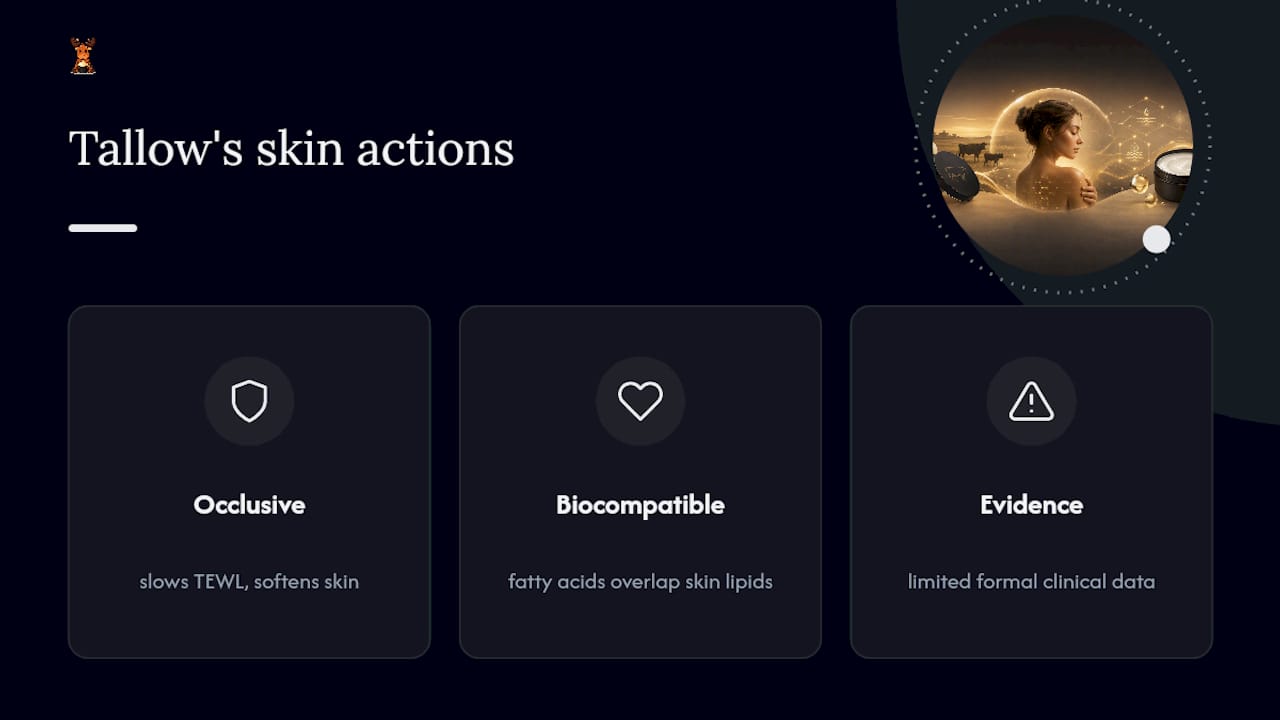
Tallow works the same way most heavy moisturizers work: it sits on top of skin and slows water loss. That’s the occlusive effect, and it’s the most defensible claim you can make about tallow.
Skin loses water constantly through a process called transepidermal water loss, or TEWL. Anything that forms a light barrier on the surface, whether it’s petroleum jelly, a plant oil, or rendered tallow, slows that loss down and helps skin feel softer and less tight. A scoping review on tallow’s biocompatibility with skin found that its fatty acids can function as an occlusive emollient capable of softening very dry skin, which lines up with what people report anecdotally.
The biocompatibility argument goes a step further. Tallow’s fatty-acid profile overlaps with the lipids already present in human skin, which is why some formulators argue it absorbs more readily than fats with a very different structure. That’s a reasonable, plausible mechanism. It is not the same as proof that tallow outperforms other moisturizers, because the clinical research simply is not there yet.
Statistic Callout: The same scoping review that supports tallow’s occlusive benefits also flags a real gap. Researchers found plausible moisturizing effects but noted that formal data on side effects and long-term skin outcomes remains limited and often indirect. In plain terms: the mechanism makes sense, but nobody has run the large, controlled studies that would confirm exactly how tallow compares to other emollients over time.
Experts covering the trend have been consistent on this point. One MD Anderson analysis put it plainly: tallow’s popularity on social media has outpaced the science backing it. That doesn’t make tallow useless. It means you should treat it as a plausible, traditional moisturizer, not a clinically proven treatment for any specific skin condition.
Is Tallow Right for Your Skin Type?
Fit depends almost entirely on what kind of skin you have and where you plan to use it.
Tallow tends to work best for:
- Chronically dry skin, especially on elbows, knees, and heels
- Rough, flaky patches that plain lotion doesn’t fix
- People comfortable with an animal-derived ingredient in their routine
- Cold-weather or wind-exposed skin that needs a heavier barrier
Tallow is a poor match, or at least worth extra caution, for:
- Oily or acne-prone skin, especially on the face and T-zone
- Active dermatitis, eczema flares, or broken skin
- Anyone with a known beef allergy or alpha-gal sensitivity
- First-time users applying a new product directly to the face
The main risk with any occlusive fat is that it can trap oil and debris in pores if you have naturally oily skin. Facial use carries more risk than body use for exactly this reason, since the oleic acid content in tallow can occlude pores that are already prone to clogging. A week-long user trial published in Vogue captured this variability well: tallow left some skin visibly softer while triggering breakouts on other testers, often depending on how oily their skin already was.
Allergic contact dermatitis is rare but real, particularly if a formula includes fragrance or other added ingredients. Redness, itching, or small bumps after use are signs to stop immediately.
Pro Tip: Apply a small amount to your inner forearm and leave it alone for 48 hours. If your skin stays calm, you’re clear to try it on drier body areas. Skip the face until you’ve tested it elsewhere first.
How to Use Tallow for Skin, Step by Step
Getting good results from tallow comes down to using it in the right amount, in the right place, at the right time.
- Patch test first. Rub a pea-sized amount into your inner forearm and wait 48 hours, watching for redness, itching, or bumps.
- Start on the body, not the face. Elbows, knees, hands, and heels are the safest first stops for anyone new to tallow.
- Use less than you think you need. A little goes a long way; tallow melts on contact with skin and spreads thin.
- Apply after a shower or bath, while skin is still slightly damp, to help lock in moisture.
- Keep it off active breakouts and away from the T-zone if your skin runs oily.
- Reapply once or twice daily, especially on cracked heels or rough patches that need ongoing attention.
- Store it cool and dry, away from direct sunlight, to protect the fat from breaking down early.
- Watch for changes in smell or color. A product that starts smelling sour or looks separated has gone off, and it’s time to toss it.
A well-formulated, water-free tallow balm holds up far longer than a water-based lotion because there’s no water content to support bacterial growth. That’s part of why small-batch application routines built around tallow tend to focus on small amounts used consistently, rather than heavy layering.
What Makes a Quality Tallow Product Worth Buying?
Not every tallow product on the market is formulated the same way, and the label tells you most of what you need to know before you buy.
Look for specific language, not vague marketing. Phrases like “properly rendered,” “water-free,” and “small-batch” signal a brand that understands what makes tallow stable and clean. If a brand names its sourcing directly, such as grass-fed beef from a specific region, that’s a stronger trust signal than a generic “natural” claim with nothing behind it.
Carrier oil choice matters more than most shoppers realize. Tallow on its own can feel dense and slow to absorb, so brands blend it with a lighter oil to improve texture. Fractionated coconut oil stands out as the strongest option here because it stays liquid at room temperature, resists oxidation better than whole coconut oil, and gives a formula a lighter, faster-absorbing feel without shortening its shelf life. That’s different from virgin coconut oil, which contains more of the compounds that make formulas prone to going rancid faster.
Ingredient count is another quick filter. A tallow balm with five or six named, functional ingredients (think beeswax for structure, vitamin E for oxidation resistance, jojoba or castor oil for added glide) tells you every ingredient earns its place. A label with 20 or more ingredients, several of them synthetic fillers, usually means the tallow is doing less work than the marketing suggests.
| What to check | Why it matters |
|---|---|
| “Properly rendered” language | Confirms impurities and moisture were removed |
| Water-free formula | Fewer preservatives needed, longer shelf life |
| Fractionated coconut oil as carrier | Lighter feel, resists oxidation, absorbs faster |
| Short ingredient list | Signals intentional formulation, not filler |
| Named sourcing (grass-fed, local) | Higher accountability than vague “natural” claims |
Skip products bulking up their ingredient list with plant oils like avocado or shea butter just to sound luxurious. Those oils aren’t wrong on their own, but adding them to a tallow formula usually means diluting the very fat you bought the product for. A tighter fractionated coconut oil and tallow pairing does more for stability than a long list of botanical extras ever will.
Why I Built Moose’s Tallow Around One Fat, Not Fifty Ingredients
A few years back, I flipped over a lotion bottle in my bathroom and counted 52 ingredients. Water was first on the list. That moment, paired with a health scare that had me looking harder at everything I put on my body, is why Moose’s Tallow exists.
I started small-batch rendering local beef suet myself, right here in Lebanon, PA. Rendering it properly, keeping formulas water-free, and skipping synthetic filler wasn’t a marketing angle. It was the whole point. Water-free formulas mean less dilution, which means the tallow actually gets to do its job on your skin instead of getting lost behind a long ingredient list.
Every batch we make backs up that claim with a 30-day guarantee. If a product doesn’t work for your skin, we want to know, and we’ll make it right. That’s not a slogan. It’s how you stay honest with people who read labels as carefully as I do.
— Brian Smith
Which Moose’s Tallow Product Fits Your Skin?
There’s a real difference between wanting tallow’s barrier-supporting benefits and finding the right format for where your skin actually needs help. Moose’s Tallow builds each product around a specific job, using the same water-free, small-batch approach across the line.
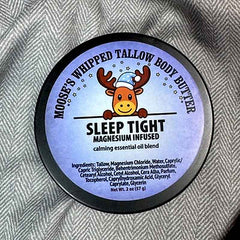
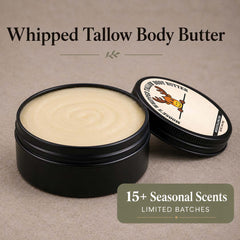
If your body skin is chronically dry, especially on elbows, knees, or rough patches that plain lotion never fixes, the Whipped Tallow Body Butter is the natural starting point. It’s whipped for easy spreading and built on properly rendered local beef suet tallow, with fractionated coconut oil keeping the texture light instead of greasy.
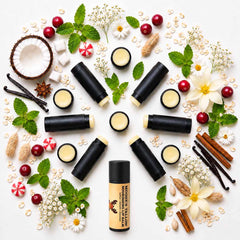
Lips crack faster than almost any other skin, and they need a small, portable fix rather than a full-size jar. The Beef Tallow Lip Balm for Dry & Chapped Lips is built for exactly that: a low-friction way to try tallow on a small, low-risk area before committing to anything bigger.
For anyone spending real time outdoors, the Tallow & Zinc Outdoor Sun Balm pairs tallow’s occlusive barrier with zinc in an anhydrous formula, no water to wash off early, no fillers diluting the fat doing the work.
Every one of these is handmade in small batches, backed by our 30-day guarantee. Start with the product that matches your driest spot, patch test it first, and go from there.
Sources
- Tallow, Rendered Animal Fat, and Its Biocompatibility With Skin: A Scoping Review - PMC
- Beef tallow benefits: what experts say — MD Anderson
- I Used Beef Tallow On My Skin For A Week—Here’s What Happened — Vogue
FAQ
Why Are Dermatologists Against Tallow?
Many dermatologists point to limited clinical research and the risk of clogged pores on oily or acne-prone skin, not evidence that tallow is unsafe for everyone. The caution is about matching the product to the right skin type, not a blanket rejection.
Does Beef Tallow Really Get Rid of Wrinkles?
No credible evidence supports tallow reducing wrinkles. Its realistic benefit is as an occlusive moisturizer that softens dry skin and supports the skin barrier, not an anti-aging treatment.
Is Suet Tallow Better Than Regular Tallow?
“Suet” refers to the raw fat before rendering, so it isn’t a separate product from tallow. Properly rendered tallow made from suet is what’s actually safe and effective for skin, while raw, unrendered suet should never be applied directly.
Which Beef Tallow Is Best for Skin?
Look for properly rendered, water-free formulas with simple ingredient lists and fractionated coconut oil as the carrier for lighter absorption and better shelf stability. Moose’s Tallow builds every product around those exact standards using small-batch, locally rendered beef suet tallow.
0 comments