
TL;DR:
- Tallow offers minimal SPF and is not a substitute for broad-spectrum sunscreen.
- Water-based sunscreens often contain chemical filters with potential systemic absorption risks.
- For effective sun protection, choose mineral sunscreens with zinc oxide and SPF 30 or higher.
Tallow is having a moment. More people are reaching for animal-fat skincare and questioning whether conventional sunscreens are actually doing them any favors. It’s a fair question, and we think it deserves an honest answer. Tallow is genuinely remarkable for skin health, but there are real differences between what it does and what a properly formulated sunscreen does. This article walks through the science, the ingredients, and the practical choices so you can decide what your skin actually needs.
Table of Contents
- Understanding tallow and water-based sunscreens
- Effectiveness and safety: Facts and falsehoods
- Skin barrier support and hydration: Where tallow shines
- Choosing what your skin actually needs
- Why conventional sunscreen advice misses the mark
- Discover truly nourishing sun care
- Frequently asked questions
Key Takeaways
| Point | Details |
|---|---|
| Tallow alone isn’t enough | Tallow offers only minimal SPF and cannot replace science-backed sunscreen for protection. |
| Mineral formulas are safest | Tallow-based sunscreens with zinc oxide provide safer, effective sun protection without hormone risks. |
| Barrier support matters most | Hydration and barrier repair are key; tallow excels, but patch test if acne-prone. |
| Choose evidence over buzzwords | Rely on verified SPF levels and broad-spectrum coverage, not just natural claims. |
Understanding tallow and water-based sunscreens
Tallow is rendered beef fat, and it has been used in skincare for centuries. Its fatty acid profile closely mirrors human sebum, which is why it absorbs so readily and feels so natural on the skin. You can learn more about tallow in skincare and why it’s drawing serious attention from the wellness community. We cover a lot of the common tallow skincare myths on our blog, and one of the biggest is that tallow alone can replace sunscreen.
Here’s the truth: tallow alone provides minimal natural SPF around 4, and it does not deliver broad-spectrum UV protection. Dermatologists are clear that it is not a sunscreen substitute. That matters, especially if you’re spending real time outdoors.
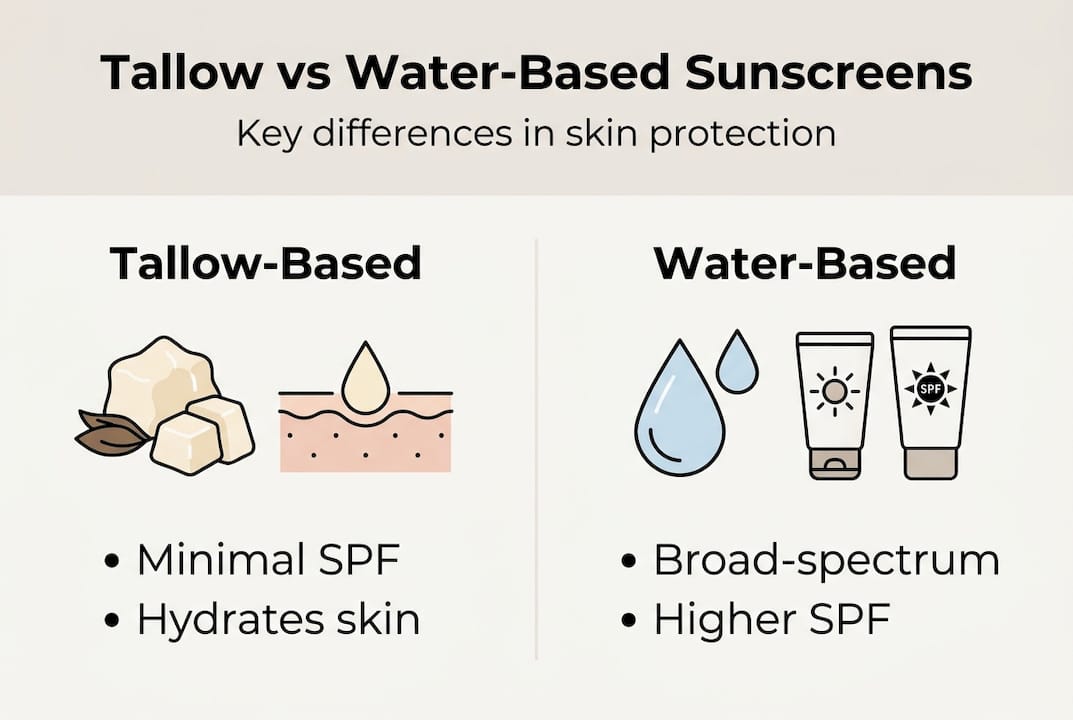
Water-based sunscreens, by contrast, are built around an aqueous base. Most are 60 to 80 percent water. That water base requires emulsifiers to blend oils in, preservatives to prevent microbial growth, and stabilizers to keep the formula from separating. You can read about the tallow benefits explained in more depth, but the key point here is that tallow-based formulas skip that entire water-dependent system.
| Feature | Tallow-based | Water-based |
|---|---|---|
| Primary base | Grass-fed tallow | Water (60-80%) |
| Preservatives needed | Minimal | Yes, required |
| Skin compatibility | Mimics sebum | Varies |
| Absorption feel | Rich, absorbs well | Lighter, can evaporate |
Pro Tip: Always confirm a sunscreen carries a broad-spectrum label and SPF 30 or higher before relying on it for outdoor protection.
With misconceptions set aside, let’s look closer at how these two sunscreen types actually defend your skin.
Effectiveness and safety: Facts and falsehoods
Mineral sunscreens work by sitting on top of the skin and physically deflecting UV rays. Chemical sunscreens absorb UV energy and convert it to heat. Most water-based sunscreens use chemical filters, which is where safety questions arise.
FDA deems only zinc oxide and titanium dioxide GRASE (Generally Recognized as Safe and Effective). That leaves 14 other commonly used chemical filters without that designation. Some have been detected in the bloodstream after a single application, raising legitimate questions about systemic absorption and potential hormone disruption. You can review the full sunscreen regulation details from EWG for more context.
Tallow-based sunscreens take a different approach. When formulated with non-nano zinc oxide at around 20%, tallow-based sunscreens deliver SPF 25 to 35 with water resistance of 35 to 60 minutes. That is meaningful, real-world protection built on ingredients your skin recognizes.
Here is what that looks like in practice:
- Zinc oxide provides true broad-spectrum UVA and UVB protection
- Tallow acts as the nourishing carrier, supporting absorption
- Beeswax adds water resistance and a natural protective layer
- Chemical filters in water-based products can absorb systemically
- Only 2 of 16 common sunscreen ingredients hold GRASE status from the FDA
The hydration benefits of tallow go well beyond what most water-based formulas can offer, especially over time.

Once you know what’s inside your sunscreen, the next step is understanding what it actually does for your skin’s barrier and hydration.
Skin barrier support and hydration: Where tallow shines
This is where tallow genuinely earns its place. The fatty acids in grass-fed beef tallow, including palmitic, stearic, and oleic acids, closely mirror the lipid structure of healthy human skin. That similarity is not cosmetic. It means tallow can actually support barrier repair rather than just sitting on the surface.
Tallow also carries fat-soluble vitamins A, D, E, and K directly into the skin. These are the same vitamins your skin uses to regulate cell turnover, reduce inflammation, and maintain elasticity. Water-based products simply cannot deliver fat-soluble nutrients the same way because the base is not compatible.
“Tallow supports the skin barrier through vitamins A, D, E, and K and fatty acids similar to sebum, with a hydration boost of 35% versus 22% for chemical-based creams after four weeks.”
For those with dry or sensitive skin, the case for tallow is strong. If you want to go deeper, we have written about dry skin tallow benefits and practical ways to maximize tallow hydration in your routine. You can also find a thorough breakdown of how tallow sunscreen details translate to real-world use.
One honest note: tallow is comedogenic for some people. If you have acne-prone or oily skin, it may clog pores or cause irritation.
Pro Tip: Patch test any tallow-based product on a small area for a few days before applying it to your face, especially if you are prone to breakouts.
Now, let’s weigh up how these facts translate to your daily routine and real-world application.
Choosing what your skin actually needs
The science points in a clear direction. Everyone needs broad-spectrum SPF 30 or higher for meaningful sun protection. The base that delivers that SPF matters just as much as the number on the label. EWG recommends mineral-only products for safety, and tallow is an excellent carrier for zinc oxide when formulated correctly.
For practical guidance on finding clean, effective options, our natural tallow product checklist is a good starting point. You can also compare formulas using the best sunscreen guidelines from trusted sources.
Here is a simple numbered checklist to help you decide:
- Confirm the label says broad-spectrum SPF 30 or higher
- Look for zinc oxide as the active ingredient
- Check the base: waterless formulas skip preservatives and fillers
- Look for EWG verification on the product or brand
- Patch test if you have oily or acne-prone skin
- Avoid DIY untested formulas when sun exposure is significant
- Choose ingredients you can actually recognize and trust
As the science gets clear, it’s important to pause and look beyond the obvious — what does this really mean for daily sun protection?
Why conventional sunscreen advice misses the mark
Honestly, the natural versus chemical debate is the wrong frame. It keeps people focused on labels instead of outcomes. What actually matters is whether your sunscreen delivers proven broad-spectrum protection and whether the base it uses supports your skin rather than just coating it.
We have seen people abandon sunscreen entirely because they distrust chemical filters, which is a real problem. The answer is not to go without protection. It is to find formulas that combine mineral SPF with a skin-compatible base. Tallow does that job well. It is not magic, and it is not a trend. It is a functional ingredient that pairs naturally with zinc oxide to create something genuinely useful.
We trust independent verification from sources like EWG over marketing claims, and we recommend you do too. Comparing tallow vs plant oils is a good way to understand why the base material makes such a difference in how your skin responds.
Discover truly nourishing sun care
Ready to put all this knowledge to work in your skincare routine? At Moose’s Tallow, we formulate our Sun Butter with grass-fed tallow, non-nano zinc oxide, beeswax, fractionated coconut oil, lecithin, and tocopherols. Every ingredient earns its place. There are no fillers, no water to evaporate, and no preservatives needed. If you want to experience what a waterless, barrier-supporting sunscreen actually feels like, explore our tallow sunscreen options and find the formula that fits your skin.
Frequently asked questions
Does pure tallow protect against sunburn?
No, pure tallow offers only SPF around 4 and does not provide broad-spectrum sun protection. It should always be paired with zinc oxide in a properly formulated sunscreen.
Are tallow-based sunscreens reef-safe?
Yes, tallow-based sunscreens with zinc oxide are generally considered reef-safe. Mineral sunscreens with a tallow-zinc base do not penetrate or disrupt marine ecosystems the way chemical filters can.
Can tallow-based sunscreens clog pores?
Tallow can clog pores or cause irritation in acne-prone skin. Patch testing is advised before applying tallow-based products to the face if you are prone to breakouts.
What SPF should I look for in a natural sunscreen?
Choose a broad-spectrum mineral sunscreen with SPF 30 or higher. EWG recommends mineral-only formulations for the best combination of safety and effectiveness.
Recommended
- Tallow product checklist 2026: Choose safe natural skincare – Moose’s Tallow
- How to Choose Tallow Moisturizer Naturally for Healthier Skin – Moose’s Tallow
- Best tallow lotion uses for 25% better skin hydration in 2026 – Moose’s Tallow
- Tallow vs Plant Oils: 22% Better Hydration for Your Skin – Moose’s Tallow


