

The fastest windburn face relief comes from three moves in order: get out of the wind, cool the skin with a lukewarm compress, then seal in moisture with a lipid-rich occlusive balm. Skip hot water, scrubs, and heavy fragrance while your skin recovers. Since windburn often travels with UV damage, check whether sun exposure played a role too, and protect skin from both going forward.
TL;DR:
- Lipid-rich occlusive balms are essential for windburn recovery, as they form a physical barrier to prevent moisture loss.
- Applying the balm immediately after gentle cleansing on slightly damp skin significantly improves retention of skin’s natural oils.
- Consistent use of barrier balms, sunscreen, and protective clothing before outdoor exposure prevents windburn from occurring.
- Windburn usually heals within one to two weeks with proper care, but signs like spreading redness or blistering require medical attention.
- Water-based lotions are ineffective long-term, as they evaporate quickly and fail to restore the skin’s natural lipid barrier.
How Do You Know It’s Windburn?
Windburn shows up fast and it’s hard to miss. Your cheeks, nose, and forehead feel tight, almost like the skin doesn’t fit right anymore. Look for:
- Redness across the cheeks, nose, and forehead
- A tight, stretched feeling when you smile or talk
- Burning or stinging, especially in a warm room
- Flaking or peeling as the top layer of skin dries out
Most windburn calms down with basic home care. But if you see blistering, spreading redness, fever, or oozing, those signs indicate a more serious condition needing medical attention. Those signs point to something that needs a clinician’s eyes on it.
What Causes Windburn, and Why Does Sunburn Come Up So Much?
Wind strips the thin layer of oil sitting on your skin’s surface. That layer normally holds moisture in. Once it’s gone, water escapes through the skin faster than it should, a process called transepidermal water loss. Your skin dries out, gets irritated, and starts to feel raw.
Here’s the part people miss: windy days are often bright, cold, and high in UV exposure, especially near snow or water that reflects sunlight back at you. That’s why windburn and sunburn frequently show up together, and why treating one without the other often falls short.
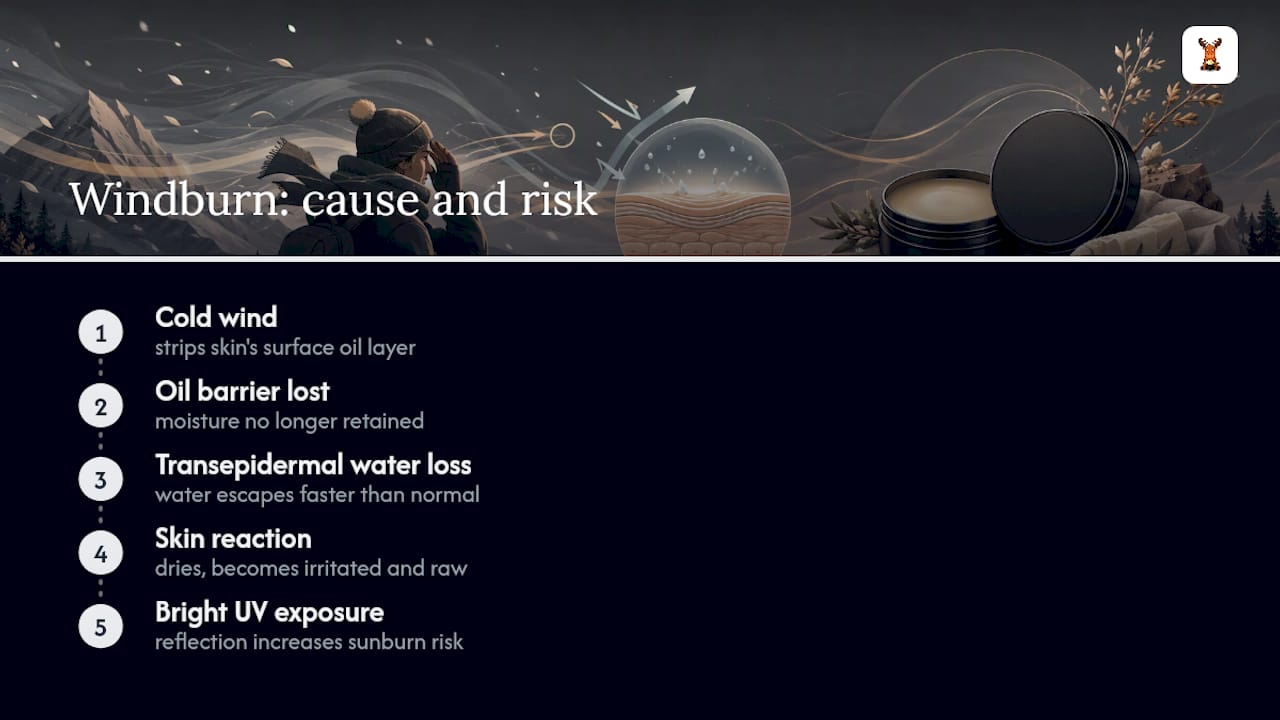
A thin, water-based lotion won’t cut it here. Water evaporates. Once it’s gone, your skin is back to square one, tight and dry again within an hour. What windburned skin actually needs is a lipid-rich occlusive, something that sits on top of skin and physically blocks moisture from escaping, rather than trying to add moisture that just leaves again.
How Do You Treat Windburn Right Now?
Follow these steps in order. Each one builds on the last.
- Get out of the wind. Head indoors or somewhere sheltered. Hold a cool, damp cloth against your face for a few minutes to calm the burning and bring down surface heat.
- Cleanse gently. Use lukewarm water and a mild, fragrance-free cleanser. Pat dry, don’t rub. Hot water feels good in the moment but pulls more moisture out of already-stressed skin.
- Seal in moisture immediately. Apply a lipid-rich occlusive balm while skin is still slightly damp. Sealing moisture in right after cleansing works better than applying it hours later once skin has already dried out again.
- Consider short-term relief. Over-the-counter pain relievers like ibuprofen or acetaminophen can take the edge off soreness. A thin layer of 1% hydrocortisone may calm redness and itch for a day or two, but keep it away from your eyes and stop if skin looks worse instead of better.
- Avoid anything that adds insult to injury. No hot showers, no exfoliating scrubs, no retinoids, no alcohol-based toners. And don’t pick at flaking skin, no matter how tempting.
Pro Tip: Apply your balm right after washing your face, not thirty minutes later. Damp skin plus an occlusive layer traps far more moisture than dry skin ever will.
What’s the Best Way to Treat Windburned Lips?
Lips have almost no oil glands of their own, so they dry out faster than the rest of your face and show damage sooner. A few habits make a real difference:
- Reach for a plain, occlusive lip balm and reapply often, not just once in the morning.
- Skip spicy food and very hot drinks until the sting settles down.
- Wrap a scarf loosely over your mouth and nose before heading back outside.
If lips crack deep enough to bleed, or a split won’t close after several days of care, get it checked. Cracks that keep reopening are prone to picking up infection.
How Long Does Windburn Last Before It Heals?
Most people notice real improvement within a couple of days of consistent care. Simple supportive steps, cooling, moisturizing, and skipping harsh products, usually bring windburn under control fast. Full healing, including any flaking or peeling, typically wraps up within a week to two weeks depending on how severe it was.
Watch for red flags that mean it’s time to call a doctor: blistering, swelling that spreads, fever, pus, or skin that looks the same or worse after several days of home care. Those aren’t things to wait out.
How Can You Prevent Windburn Before It Starts?
Prevention beats treatment every time, and it doesn’t take much effort once it’s a habit.
- Apply a barrier balm before you head outside, and reapply if you’re out for more than an hour or two.
- Layer sunscreen with your barrier balm since wind raises your skin’s sensitivity to UV, particularly around snow or water.
- Wear a scarf or neck gaiter over your lower face, and goggles if you’re on a bike, boat, or ski slope.
- Choose smooth, soft fabrics against your skin. Rough wool or scratchy synthetics add friction on top of wind damage.
- Run a humidifier indoors during dry winter months, and keep showers warm instead of scalding.
Pro Tip: If you’re heading into wind and sun at the same time, apply your barrier balm first, let it settle for a minute, then layer sunscreen on top. Product order matters more than people think.
Why Lipid-Rich Balms Work for Windburn Recovery
Windburned skin has lost its natural oil layer, and restoring that lipid matrix is what actually rebuilds the barrier. That’s the whole logic behind Moose’s Tallow: every formula starts with properly rendered local beef suet tallow, sharing a fatty-acid profile close to your skin’s own oils. It’s not diluted with water that just evaporates and leaves you tight again by lunch.
We use fractionated coconut oil as our carrier because it stays stable, resists oxidation, absorbs cleanly, and holds up on the shelf better than heavier vegetable oils. You won’t find olive, avocado, or shea butter in our formulas. We build around tallow, fractionated coconut oil, beeswax, vitamin E, jojoba, castor, and egg yolk infused oil, and nothing goes in that isn’t doing real work.
Here’s how our lineup maps to windburn scenarios:
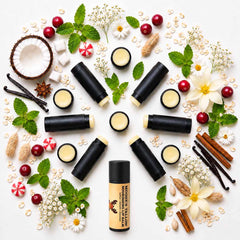
- Chapped, cracked lips: Beef Tallow Lip Balm for frequent reapplication on thin, exposed skin.
- Combined sun and wind exposure: Tallow & Zinc Outdoor Sun Balm for outdoor days.
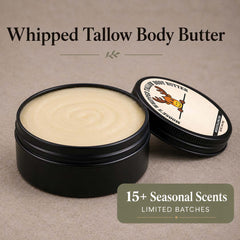
- Dry, tight facial skin overall: Whipped Tallow Body Butter for a richer, all-over layer.
- Sensitive or gentle-care needs: Baby Bum Butter for a softer formula.
I started this brand after flipping over a lotion bottle and counting 52 ingredients, water listed first. Every product we make since then is water-free, small-batch, and backed by a 30-day guarantee.
What Should You Do for Your Skin After Windburn Clears Up?
Windburn doesn’t just fade and disappear from your skin’s memory. The barrier that got stripped needs real time to rebuild itself, and how you treat your face in the weeks after matters as much as what you did on day one.
Keep using a lipid-rich moisturizer daily, even after redness is gone. Skin that looks fine on the surface can still be working to restore its oil layer underneath. Dropping back to thin, water-based lotions too soon often means you’re right back to tight, dry skin the next time wind picks up.
Hold off on exfoliants, strong actives, and fragranced products for at least a week or two past visible healing. Your skin needs calm, not a new challenge to respond to.
Build a routine around gentle cleansing, consistent moisture, and daily sun protection, since damaged skin barriers are more reactive to UV for a while after recovery. If you spend a lot of time outdoors, treat barrier balm and sunscreen as a pair, not separate steps you remember only sometimes.
Think of barrier repair as ongoing maintenance rather than a one-time fix. Skin exposed to wind, cold, or sun regularly benefits from year-round care, not just treatment after damage shows up.
Is It Windburn, Eczema, or Something Else?
Windburn gets mistaken for other skin conditions fairly often, and getting the cause right changes what actually helps.
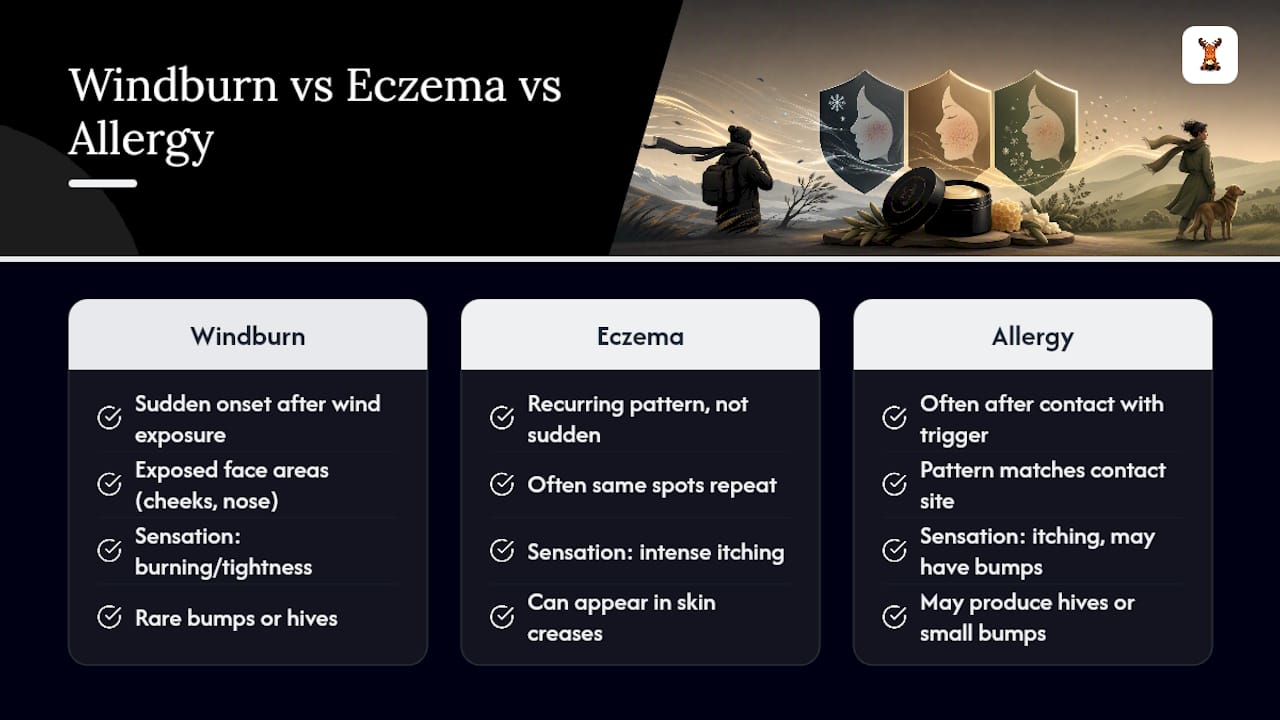
Windburn tends to appear suddenly, right after time outdoors in cold or gusty conditions, and it’s usually limited to exposed areas: cheeks, nose, forehead, lips. It responds fairly quickly to cooling, gentle cleansing, and a rich barrier balm.
Eczema, on the other hand, tends to be a recurring pattern rather than a one-time event. It often shows up in the same spots repeatedly, can involve more intense itching than burning, and sometimes appears in body creases as well as the face. Eczema flares often need ongoing management rather than a quick fix, and they don’t always trace back to a specific weather event.
Allergic reactions, including contact dermatitis from a new skincare product or fabric, usually bring more itching than tightness, and the pattern often matches exactly where the trigger touched your skin, like a mask strap or a new moisturizer. Reactions can also involve small bumps or hives, which windburn doesn’t typically produce.
If your skin reacts the same way indoors, away from wind and sun, or the pattern keeps repeating regardless of weather, it’s worth asking a dermatologist to take a look rather than assuming it’s windburn again.
What Actually Soothes Windburned Skin?
Not every soothing ingredient does the same job, and knowing the difference saves you from products that feel nice for an hour and do nothing after that.
Aloe vera offers a cooling sensation and light hydration, which feels good in the first few minutes after exposure. But aloe alone is thin and water-based, so it evaporates fast and won’t hold up as your only treatment.
Ceramides matter because they’re a natural part of your skin’s own barrier structure. Some research on barrier-supporting ingredients shows genuine interest in actives that help rebuild that structure, though the most dependable approach still comes down to replenishing lipids directly and sealing them in with an occlusive layer.
Hyaluronic acid pulls moisture toward the skin’s surface, which can help if you follow it immediately with something that locks that moisture in. Used alone, especially in dry or windy air, it can actually pull moisture out of deeper skin layers instead.
That’s the practical case for a lipid-rich, water-free balm over a string of separate serums. One layer of tallow-based balm, applied to slightly damp skin, does the sealing job that a whole shelf of thin products often can’t manage on their own.
What the Research Actually Supports
The internet loves complicated skincare routines for windburn: five serums, a dozen steps, ingredients most people can’t pronounce. The research doesn’t back that up. What actually helps is boring in the best way: get out of the wind, cool the skin, replace the lipids it lost, and keep it protected from sun and cold going forward.
Where conventional advice falls short is the moisturizer step. Most drugstore lotions are mostly water, and water evaporates. That’s not a small detail. Your skin ends up back where it started within an hour, and a lot of people conclude their windburn “isn’t responding” when really their product just isn’t built to hold up.
Prioritize occlusion first. A thick, lipid-rich balm applied to slightly damp skin does more real work than an expensive serum with a longer ingredient list. Everything else, sunscreen, physical barriers, gentle cleansing, supports that one core job: keeping the water your skin has left from escaping.
— Brian Smith
Which Moose’s Tallow Balm Fits Your Windburn Right Now?
You’ve got real options here, not a guessing game. If your lips took the worst of it, our Beef Tallow Lip Balm goes on thick and stays put through reapplications, no thin coating that disappears in ten minutes. Heading back outside into wind and sun together? The Tallow & Zinc Outdoor Sun Balm pairs barrier lipids with zinc protection in one layer. And if your whole face feels tight and dry, not just one spot, the Whipped Tallow Body Butter covers more ground without leaving that greasy film thinner lotions can’t avoid.
Every one of these is water-free, built on properly rendered local beef suet tallow, and made in small batches with nothing thrown in as filler. If a formula doesn’t work for your skin, our 30-day guarantee has you covered. Browse the full natural winter skincare collection and pick the balm that matches what your face needs today.
Sources
- How to Prevent And Treat Windburn, Winter’s Overlooked Skin Condition | GW School of Medicine and Health Sciences
- Lipid replacement and skin barrier repair (PMC article)
- Windburn: Definition and remedies — Medical News Today
FAQ
Does Aquaphor Help Windburn?
Petrolatum-based products can help seal in moisture on windburned skin since they work as an occlusive layer. A water-free, lipid-rich balm offers a similar sealing effect while adding fatty acids closer to what your skin naturally produces.
What Is the Best Cream for Windburn on the Face?
Look for a thick, water-free, lipid-rich balm rather than a thin lotion, since water-based products tend to evaporate and leave skin tight again. Balms built on tallow or similar occlusive bases hold up longer than lotions that list water as the first ingredient.
How Long Does Windburn on the Face Typically Last?
Most windburn improves within a couple of days with consistent care, and full healing, including any peeling, usually takes about a week to two weeks depending on severity.
What Does a Windburned Face Look Like?
Windburn typically shows up as redness, tightness, and sometimes flaking across the cheeks, nose, and forehead, the areas most exposed to wind. It can look similar to mild sunburn, and the two conditions frequently occur together after time outdoors in cold, bright conditions.
0 comments