

Yes, fragrance-free deodorant can control odor well for many people, and it lowers your risk of fragrance-driven irritation. That matters if your skin reacts to scented products or so-called “unscented” ones that still hide masking fragrance. Deodorants and antiperspirants do different jobs too, so picking the right one starts with knowing what you actually need.
TL;DR:
- Choose products labeled fragrance free, not merely unscented: masking fragrance may remain, and labels can list a hidden blend simply as fragrance.
- Deodorants limit odor but do not reduce sweating; choose an antiperspirant containing aluminum salts if lowering sweat volume is the priority.
- Test a new formula on your forearm and wait 24 to 48 hours before underarm use; stop if irritation appears.
- Fragrance free does not guarantee irritation free: baking soda, certain alcohols, or minerals may also bother reactive skin, so check the full ingredient list.
What “fragrance-free” vs “unscented” means for your skin
These two words look similar on a label. They are not the same thing.
Fragrance-free means no fragrance ingredients were added at all. Unscented means a product may still contain fragrance chemicals, just enough to cancel out any smell you’d notice. Dermatology guidance from the American Academy of Dermatology points out that these masking fragrances can still trigger a reaction, even though the product smells like nothing.
That matters because your skin does not care whether a scent is pleasant or hidden. A masking fragrance is still a fragrance chemical sitting on your skin for hours.
Reading labels gets harder because of how fragrance ingredients get listed. The FDA explains that companies can list “fragrance” as one single word on a label, with no requirement to name what’s actually inside it. That one word can represent dozens of chemicals.
A few quick distinctions to keep straight:
- “Fragrance-free” means no added fragrance ingredients, full stop.
- “Unscented” can still include masking fragrance you cannot smell.
- The word “fragrance” on a label can hide multiple unnamed ingredients.
- Essential oils still count as fragrance, even in natural products.
If you react to scented products, fragrance-free is the safer place to start. Unscented is not automatically a safer substitute.
How fragrance-free deodorants actually control body odor (vs antiperspirants)
Deodorants and antiperspirants solve two different problems, and mixing them up leads to disappointment.
A deodorant targets odor. It works by limiting the bacteria that break down sweat into smell, and often uses absorbent ingredients or pH-balancing agents to keep things fresh. It does not stop you from sweating.
An antiperspirant works differently. It uses aluminum salts to temporarily block sweat glands, which reduces how much you sweat in the first place. The FDA’s antiperspirant monograph treats antiperspirants as over-the-counter drugs, with their own labeling and testing rules. That’s a different regulatory category than a cosmetic deodorant.
Mayo Clinic notes that deodorants reduce odor but don’t stop sweating, while antiperspirants reduce sweat itself through aluminum salts. Knowing which outcome you want decides which product fits.
Here’s what that means day to day:
- On a normal day, a fragrance-free deodorant can manage odor well for most people.
- During heavy exercise or heat, you may still sweat normally, since odor control and sweat control aren’t the same function.
- If sweat volume is your main concern, an antiperspirant addresses that directly, while a deodorant does not.
- Reapplying midday can help during longer or more active stretches.
Fragrance-free deodorants are not a miracle sweat-stopper, and they were never meant to be. They handle smell, and they tend to do that job well without adding fragrance chemicals to the mix.
Who benefits most: skin-sensitivity and dermatology perspective
If your skin is reactive, this section is for you.
Fragrance is one of the most common triggers for contact dermatitis, according to AAD guidance on contact dermatitis. Choosing fragrance-free products lowers your exposure to one of the biggest known irritants in personal care.
You may be a strong candidate for fragrance-free deodorant if you notice:
- Repeated redness, itching, or rash in the underarm area.
- A known allergy or sensitivity to fragrance or essential oils.
- Irritation that shows up a day or two after switching scented products.
- Skin that reacts to “unscented” items, which often still contain masking fragrance.
Dermatologists generally recommend patch testing any new product before full use, and stopping immediately if irritation shows up.
Pro Tip: Apply a small amount to the inside of your forearm and wait 24 to 48 hours before using a new deodorant under your arms.
Switching to fragrance-free doesn’t guarantee zero reactions. Other ingredients, like certain alcohols or added minerals, can irritate sensitive skin too. Fragrance-free simply removes one major, well-documented variable from the equation.
A practical label checklist: what to look for when you buy
Reading a deodorant label takes under a minute once you know what to scan for.
- Scan the ingredient list for the single word “fragrance” or “parfum,” which can represent a hidden blend of chemicals.
- Check whether the product says “fragrance-free” specifically, rather than just “unscented.”
- Watch for essential oils listed by name. They’re natural, but they still count as fragrance.
- Look at other common irritants like baking soda, certain alcohols, or added minerals if your skin is reactive.
- Pay attention to the carrier oil used in the formula. A stable, low-odor carrier like fractionated coconut oil holds up better over time than oils prone to going rancid.
- Remember that fragrance can hide behind a single word on the label, since the FDA permits broad fragrance labeling without listing every chemical inside it.
If a brand lists its full ingredients clearly and explains why each one is there, that transparency is worth something. It means you’re not guessing what’s actually touching your skin.
How to switch to fragrance-free deodorant, step by step
Switching products works best with a little patience, not a cold swap.
- Patch test the new deodorant on a small area of skin first, then wait a day or two.
- Apply to clean, dry underarms once the patch test looks clear, following the product’s directions.
- Give it several days of regular use before judging how well it controls odor.
- During busier or more active days, consider a midday reapplication to stay ahead of odor.
- If irritation shows up at any point, stop using the product and try a different formula.
- See a clinician if you notice persistent rash, or if sweating itself is the bigger problem you’re trying to solve.
Pro Tip: Switch deodorants at the start of a calmer week, not right before a big workout or event, so you can judge performance fairly.
Give your skin a short adjustment window. Most people notice within the first week whether a fragrance-free formula works for them.
Why Moose’s Tallow formulates fragrance-free deodorant this way
We build every product on properly rendered local beef suet tallow, and our deodorant is no exception. We keep formulas water-free and lightly diluted, because skin doesn’t need a long ingredient list. It needs the right ingredients, chosen on purpose.
Here’s what goes into our deodorant and why:
- Grass-fed, locally rendered tallow forms the base, with a fatty-acid profile close to your skin’s own oils.
- Fractionated coconut oil works as our carrier oil of choice, since it resists oxidation, absorbs easily, and holds up well on the shelf.
- Beeswax helps give the balm its texture and staying power.
- Vitamin E (tocopherols) supports the formula’s stability.
- Jojoba and castor round out the oil blend without adding fragrance.
- Egg yolk infused oil is part of select formulas, chosen for a reason, never as filler.
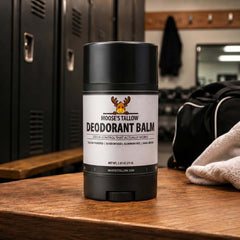
We make everything by hand in small batches. If you want to see the formula for yourself, our aluminum-free deodorant balm lays out exactly what’s inside.
Impact of fragrance-free deodorants on skin microbiome balance
Your underarm skin hosts a mix of bacteria, and that balance plays a role in both skin comfort and odor.
Fragrance chemicals and certain preservatives can disrupt that balance over time, especially with daily reapplication in a warm, enclosed area like the underarm. Fragrance-free formulas remove one layer of chemical exposure from that environment.
This doesn’t mean fragrance-free products are a cure for skin issues, and we won’t claim that. It means there’s one less variable working against your skin’s natural state. A simpler formula, with fewer added chemicals, gives your skin less to adapt to or fight against.
For people who’ve noticed ongoing irritation under scented products, removing fragrance is often one of the first and simplest changes worth trying. It’s a small shift with a reasonable chance of making daily wear more comfortable.
Comparing natural fragrance-free deodorants with conventional ones
Conventional deodorants often rely on synthetic fragrance, alcohol bases, and a longer ingredient list to hit a specific scent and feel. Natural fragrance-free versions tend to strip that back to fewer, more purposeful ingredients.
On odor control, both approaches can work well, since the mechanism (limiting bacteria and absorbing moisture) doesn’t require synthetic fragrance to function. The real difference shows up in skin feel and irritation risk over time.
A water-free, tallow-based formula skips the water-and-filler approach entirely. Instead of diluting the product down, every ingredient is there to do a job, whether that’s absorption, texture, or skin-barrier support. Conventional formulas, by contrast, often use water as a base ingredient along with the synthetic components that keep manufacturing costs down.
Neither style is right for every single person. But if your priority is fewer unknown ingredients and a lower chance of fragrance-triggered irritation, natural fragrance-free formulas give you a clearer picture of what’s touching your skin.
Potential long-term benefits of avoiding fragrances for overall skin health
Skipping fragrance isn’t just a short-term comfort choice. Over months and years of daily use, it can add up.
Underarm skin gets reapplied product nearly every day, often for decades. Repeated low-level exposure to fragrance chemicals, even ones that don’t cause an immediate reaction, can wear on skin that’s already thin and sensitive in that area.
Choosing fragrance-free consistently means your skin isn’t quietly absorbing added fragrance chemicals day after day. Over time, that may support calmer, more resilient skin, particularly for anyone prone to dryness or occasional flare-ups.
This is a reasonable, cosmetic-level benefit, not a guarantee or a treatment claim. Simpler formulas with fewer added chemicals are simply less work for your skin to process. For people building a long-term routine, that’s a meaningful reason to default to fragrance-free as a baseline choice rather than an occasional swap.
The role of tallow in fragrance-free deodorants for skin barrier support
Tallow isn’t just a base ingredient we chose at random. Its fatty-acid profile sits close to what your own skin naturally produces, which is part of why it tends to absorb cleanly rather than sitting on top of skin.
In a fragrance-free deodorant, that matters even more, since there’s no added scent to mask how a formula actually performs. The tallow has to do real work on its own: supporting the skin barrier while the rest of the formula handles odor control.
We pair tallow with fractionated coconut oil, beeswax, and vitamin E, rather than vegetable oils like olive, shea butter, or avocado. Those common fillers don’t share tallow’s fatty-acid profile, and we’d rather build around ingredients that actually complement skin, not compete with it.
The result is a deodorant balm where every ingredient earns its place. Tallow leads, fractionated coconut oil stabilizes the texture, and nothing is added just to bulk up the ingredient list.
Environmental and health advantages of choosing fragrance-free, natural deodorants
Fragrance-free products carry benefits beyond your own skin.
The EPA’s Safer Choice program points out that fragrance-free choices reduce exposure to added fragrance chemicals, which can matter for indoor air quality and for people sensitive to airborne fragrance, not just skin contact.
Natural, water-free formulas also tend to use fewer synthetic preservatives and fillers overall. Fewer added chemicals in the jar generally means fewer chemicals washed down the drain or released during manufacturing.
Health-wise, the advantage circles back to exposure. Every fragrance-free product you use is one less daily source of fragrance chemicals building up across your personal care routine, from deodorant to lotion to laundry soap. If you’re also rethinking fragrance exposure through fabric and textile choices, especially for a baby or sensitive family member, guidance on hypoallergenic fabrics covers that angle well.
None of this means fragrance-free products treat or cure anything. It means you’re choosing a simpler chemical footprint, both for your skin and the air around you.

Author perspective: a simple-ingredient approach to fragrance-free care
I started this brand after a health scare pushed me to actually read my own lotion label. It listed 52 ingredients, and the first one was water. That didn’t sit right with me.
So I built something simpler, around tallow instead of water and fillers. That same thinking shapes every recommendation here: fragrance-free first, fewer ingredients, each one chosen on purpose. Your skin is different from mine, so patch test anything new, and trust what your own skin tells you.
— Brian Smith
Try fragrance-free deodorant from Moose’s Tallow
We built our deodorant line around one goal: real odor control without fragrance chemicals getting in the way of sensitive skin. Every formula starts with properly rendered beef suet tallow, water-free and lightly diluted, with fractionated coconut oil as the carrier oil.
- Our Aluminum-Free Natural Deodorant, Tallow Balm gives you a fragrance-free, water-free formula built on tallow.
- Our Forest Falls Deodorant offers another fragrance-free option from the same small-batch process.
- Every order ships with our satisfaction promise.
- Heading outdoors too? Our Hiker’s Friend bug and tick repellent follows the same tallow-first approach.
Browse our full deodorant and skincare collection, and patch test any new formula first if your skin tends to react.
FAQ
Why do some deodorants use aluminum-free formulas?
Aluminum-free deodorants skip the sweat-blocking salts found in antiperspirants and focus on odor control instead. This suits people who want to avoid aluminum on their skin or who only want odor managed, not sweat reduced. It’s a formulation choice tied to a different goal than antiperspirants serve.
What is the best deodorant to use with cologne?
A fragrance-free deodorant is generally the safer pairing with cologne, since it won’t compete with or alter the scent you’ve chosen. Layering two fragrances, even a faint “unscented” deodorant and a cologne, can clash or shift how either one smells on your skin.
What are the benefits of using aluminum-free deodorant?
Aluminum-free deodorant focuses purely on odor control, often with simpler formulas and fewer added chemicals. For people with sensitive skin or aluminum sensitivity, it offers a way to manage daily odor without that ingredient category. It won’t reduce sweat volume, since that’s an antiperspirant function.
Are unscented deodorants good?
Unscented deodorants can work fine for odor control, but they may still contain masking fragrance you can’t smell. According to AAD guidance, fragrance-free is generally the better choice if your skin reacts to fragrance, since it skips added fragrance entirely rather than masking it.
Is fragrance-free deodorant better for sensitive skin?
For most people with reactive or sensitive skin, fragrance-free deodorant lowers the chance of irritation compared with scented or masked “unscented” options. It removes one of the most common triggers for contact dermatitis. Patch testing any new formula still helps confirm it works for your specific skin.
Sources
- Fragrances in cosmetics | FDA
- Contact dermatitis: itchy rash | American Academy of Dermatology (AAD)
- Sweating and body odor - Symptoms & causes | Mayo Clinic
- OTC Monograph: Antiperspirant Drug Products for OTC Human Use | FDA
- Fragrance-free factsheet | EPA Safer Choice
0 comentarios