

Ingredient trustworthiness determines whether a product supports your skin barrier or quietly works against it. When a formula uses fewer, intentional ingredients, your skin gets what it needs without the guesswork. Simpler formulas reduce irritation risk and improve tolerance, especially for dry or sensitive skin. Water-free, minimally diluted products take that principle further by concentrating every ingredient toward a real purpose.
TL;DR: What to do right now
- Scan the ingredient list. Shorter is usually better.
- Check whether water appears first. If it does, the formula is diluted.
- Look for sourcing claims you can verify, like grass-fed or locally rendered.
- Ask the brand to explain what each ingredient does.
- Avoid products with “proprietary blend” or no INCI list.
Why does ingredient trustworthiness matter for your skin?
The role of ingredient trustworthiness goes beyond label reading. It directly affects how your skin responds. Fewer, intentionally chosen ingredients reduce the chance of irritation and make it easier to identify what works. For sensitive or compromised skin, that clarity is protective.
Dermatology research supports a “simplest is best” approach for barrier repair formulations. Occlusives, humectants, and physiologic lipids do the work. Extra additives often add complexity without adding benefit.
Transparency also builds shopper confidence. Surveys show consumers want full ingredient lists and independent verification to feel confident in what they buy. When a brand explains each ingredient’s role clearly, you can make a real decision rather than a hopeful one.
- Look for brands that name each ingredient and explain its function.
- Prefer products with sourcing details you can trace.
- Prioritize barrier-supporting claims backed by a short, clean ingredient list.
Pro Tip: When shopping for barrier support, look for products that list physiologic lipids, like tallow or jojoba, near the top of the ingredient list. Position matters.
How do you judge whether an ingredient is trustworthy?
Trust ingredients that are few, functional, and explained. That is the core checklist. Ingredient credibility factors come down to what is on the label and how honestly it is presented.
- Count the ingredients. Fewer is a signal of intentionality.
- Check INCI order. Ingredients are listed from highest to lowest concentration. The first five tell you most of what matters.
- Look for role explanations. Does the brand say why each ingredient is there?
- Check for water. Water first means dilution first.
- Verify sourcing claims. Grass-fed, locally rendered, or small-batch are claims you can ask about.
- Find the preservative. Every product needs a preservation strategy. If it is not listed or explained, ask.
A trustworthy listing looks like: beef suet tallow, fractionated coconut oil, beeswax, vitamin E. A vague one looks like: aqua, glycerin, fragrance, proprietary blend.
- Independent verification and third-party certifications add a layer of confidence beyond brand claims.
- Customer reviews from verified buyers are another practical signal.
Pro Tip: Search the brand’s website for a dedicated ingredient page or FAQ. Brands with nothing to hide usually explain their choices openly.
What ingredients should you trust in natural skincare?
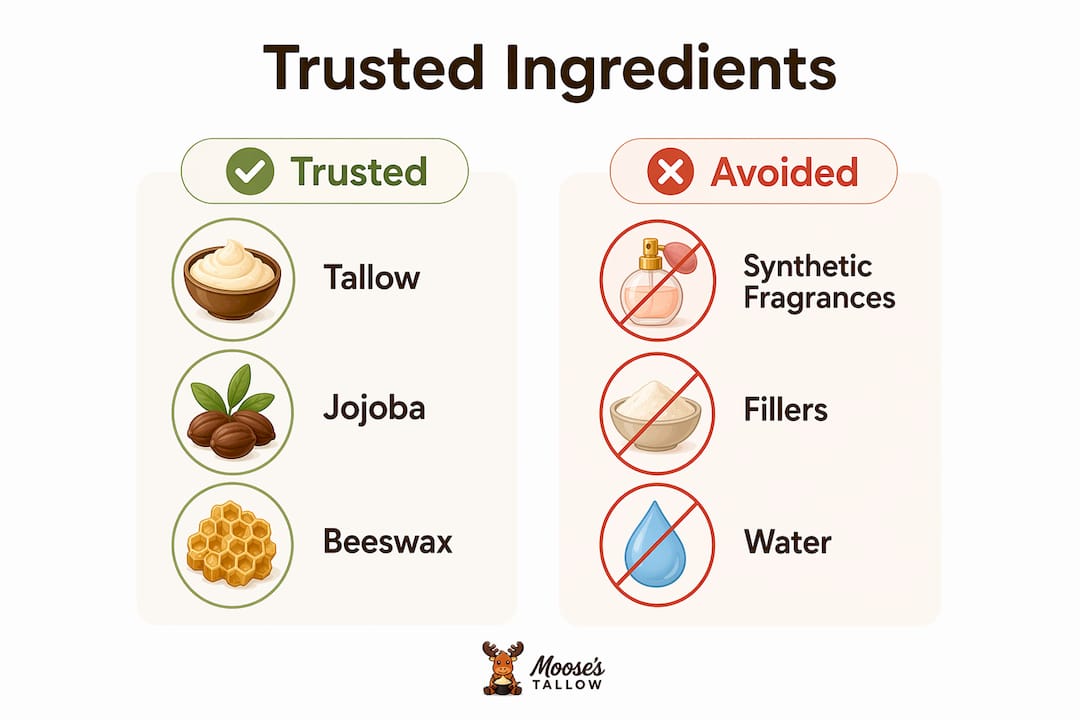
A short set of well-chosen ingredients can do more for your skin than a long list of fillers. Water-free, tallow-based formulas concentrate functional lipids so every ingredient earns its place.
- Beef suet tallow. Its fatty acid profile closely mirrors your skin’s own oils. It absorbs cleanly and supports the skin barrier without greasy residue.
- Fractionated coconut oil. The preferred carrier oil for stability, oxidation resistance, easy absorption, and shelf life. It outperforms many whole vegetable oils on all four counts.
- Beeswax. A natural occlusive that seals moisture and provides texture without synthetic thickeners.
- Vitamin E (tocopherols). Protects the formula from oxidation and supports skin conditioning.
- Jojoba. A stable wax ester that mimics skin sebum and absorbs without clogging.
- Castor oil. Adds slip and thickness; supports barrier function in small amounts.
- Egg yolk infused oil. Rich in phospholipids that complement tallow’s fatty acid profile.
These ingredients are intentionally chosen. Each one has a clear role. None is filler. That is what skin barrier support actually looks like in a formula.
Which ingredients do we avoid, and why?
Certain common oils are excluded from Moose’s Tallow formulas. The reason is stability and function, not trend. Many vegetable oils are prone to oxidation, which shortens shelf life and can introduce rancidity. They also tend to require more additives to stay stable.
- Olive oil. High in oleic acid; oxidizes relatively quickly and can disrupt barrier function with prolonged use.
- Avocado oil. Rich but unstable; prone to rancidity without antioxidant support.
- Almond oil. Mild carrier but lower oxidative stability than fractionated coconut oil.
- Shea butter. Widely used but can feel heavy and requires emulsification in water-based systems.
- Grapeseed oil. High in polyunsaturated fats; oxidizes faster than stable alternatives.
- Emu oil. Not used; sourcing and consistency vary widely.
Fractionated coconut oil replaces all of these as the carrier of choice. It resists oxidation, absorbs easily, and extends shelf life without synthetic stabilizers. Complex formulas with many inactive additives can impair barrier efficacy. Keeping the carrier stable and simple avoids that problem entirely.
What label and marketing red flags should you watch for?
Vague buzzwords often mask weak or diluted formulas. Knowing what to look for helps you avoid products that hide their formulation weaknesses behind marketing language.
- “Natural” with no explanation. The word has no regulated definition in US cosmetics.
- “Proprietary blend.” This hides what is actually in the product and at what concentration.
- No INCI list. Every legitimate cosmetic product sold in the US must carry one.
- Long, unbroken ingredient lists. Thirty-plus ingredients often signal fillers, emulsifiers, and synthetic stabilizers added to support a water base.
- Vague preservative info. “Preserved naturally” without naming the preservative is a red flag.
- Generic sourcing claims. “Sustainably sourced” without specifics is not a verifiable claim. Consumers distrust vague sustainability claims and want independent verification.
You might see phrases like “infused with nature’s best” or “clean formula” with no ingredient list to back them up. Those phrases tell you nothing about what is actually on your skin. Learning to avoid harsh or misleading ingredients starts with recognizing these patterns.
How do you read an ingredient list like a pro?
The first few ingredients tell you most of what matters. Everything after the midpoint of a long list is usually present at very low concentrations.
- Find water first. If “aqua” or “water” is the first ingredient, the formula is primarily water. Everything else is diluted.
- Read the top five. These make up the bulk of the product. Know what they are and why they are there.
- Spot the carrier oil. Is it stable? Is it listed near the top or buried at the bottom?
- Identify preservatives and fragrances. These are often listed near the end. Fragrance in particular can mask dozens of undisclosed chemicals.
- Look for role explanations. Some brands add short purpose notes in parentheses. That is a trust signal.
Confusion about ingredient labels is one of the top shopping barriers for consumers. Clear, educational labels help you choose correctly. For ceramides specifically, note that proper formulation matters: undissolved ceramides may not deliver the barrier benefit the label implies. A short, well-formulated list beats a long one with poorly dispersed actives. For a deeper walkthrough, evaluating skincare ingredients step by step is worth bookmarking.
What questions should you ask a brand before buying?
Ask for ingredient role, origin, and preservation details. Good brands answer these without hesitation.
- “What does each ingredient do?” A trustworthy brand explains every item on the list.
- “Where is your tallow or key oil sourced?” Look for grass-fed, locally rendered, or traceable sourcing.
- “Is this formula water-free?” If not, ask where water appears in the INCI order.
- “How is the product preserved?” Every formula needs a strategy. Ask for the specific preservative or method.
- “What is the shelf life, and how was it determined?” Small-batch products should have a clear answer.
- “How large are your production batches?” Small-batch claims should come with a real number or process description.
- “Do you have third-party testing or certifications?” Independent verification is the strongest trust signal available.
A good answer is specific. A weak answer is vague or deflects to marketing language. Personalized skincare guidance from a qualified professional can also help you frame the right questions for your skin type.
What do price, packaging, and small-batch claims actually signal?
Price and packaging give signals, but neither is proof of quality on its own. A $40 product in a glass jar is not automatically better than a $15 one in a simple tin.
- Higher price can reflect quality ingredients, small-batch production, or careful sourcing. It can also reflect marketing spend.
- Glass packaging reduces leaching risk and signals a brand that thought about material contact. But it is not required for a clean formula.
- UV-protective packaging matters for oxidation-sensitive formulas. Ask whether the carrier oil requires it.
- “Small-batch” claims mean different things. Ask about actual batch size and how often formulas are made fresh.
- Shelf-stability information should be available. Ask about the preservative strategy and whether the product carries a period-after-opening symbol.
Pro Tip: Ask for a batch date or lot number. Brands that make products in genuine small batches can usually provide one. If they cannot, the “small-batch” claim may be marketing language.
How does Moose’s Tallow demonstrate ingredient trustworthiness in practice?
Moose’s Tallow uses short, intentional ingredient lists and clear sourcing statements as its primary trust signals. Every product is built on properly rendered local beef suet tallow, handmade in small batches in Lebanon, PA.
- Water-free formulas. No dilution. Every ingredient is functional.
- Local beef suet tallow. Grass-fed, locally rendered, and the foundation of every product.
- Small-batch production. Made by hand in Lebanon, PA, and shipped across the US.
- Clear ingredient roles. Each ingredient is chosen on purpose and explained.
- 30-day satisfaction guarantee. Backed by real customer reviews.
Two products that show this approach clearly:
Beef Tallow Lip Balm for Dry & Chapped Lips uses tallow, fractionated coconut oil, beeswax, and vitamin E. Four ingredients. Each one has a job. The formula is water-free, so nothing is diluted away.
Beef Tallow Hand Cream for Dry, Cracked Hands follows the same logic. Tallow as the base, fractionated coconut oil as the stable carrier, beeswax for occlusion, and vitamin E for protection. No fillers, no synthetic thickeners.
Fractionated coconut oil is the preferred carrier in every Moose’s Tallow formula because it resists oxidation, absorbs cleanly, and extends shelf life without synthetic stabilizers. It is not a filler. It is a deliberate choice.
Key Takeaways
Trustworthy ingredients support your skin barrier, reduce irritation risk, and give you the clarity to make confident skincare choices.
| Point | Details |
|---|---|
| Short lists signal intent | Fewer ingredients usually mean each one was chosen on purpose, not as filler. |
| Water-free means concentrated | No water in the formula means every ingredient is functional, not diluted. |
| Sourcing claims need specifics | Grass-fed, locally rendered tallow is verifiable; generic “natural” claims are not. |
| Red flags to avoid | Watch for “proprietary blend,” missing INCI lists, and vague preservative info. |
| Moose’s Tallow approach | Water-free, tallow-first formulas with short ingredient lists, local sourcing, and a 30-day guarantee. |
Why simple formulas are the honest choice
Most people never flip over their lotion bottle. I did, after a health scare, and what I found changed everything. Fifty-two ingredients. Water listed first. I had no idea what most of them were or why they were there.
That moment is why Moose’s Tallow exists. We use local beef suet tallow because its fatty acid profile is close to your skin’s own oils. We use fractionated coconut oil because it is stable, absorbs cleanly, and does not need synthetic support to stay fresh on the shelf. We add beeswax, vitamin E, jojoba, castor, and egg yolk infused oil because each one does something specific. Nothing is there to pad the list.
If you read labels and care about what goes on your skin, you deserve a brand that answers your questions directly. That is what we try to be.
Transparent, water-free skincare from Moose’s Tallow
If you want a formula with nothing to hide, Moose’s Tallow is a straightforward option. Every product is water-free, built on locally sourced beef suet tallow, and made in small batches in Lebanon, PA.
The Beef Tallow Lip Balm is a good starting point for dry or chapped lips. Four ingredients. No water. No guesswork. The Beef Tallow Hand Cream is built for dry, cracked hands that need real barrier support, not a lotion that fades in an hour. Both are backed by a 30-day satisfaction guarantee. Browse the full collection to find the right fit for your skin.
FAQ
What does ingredient trustworthiness mean in skincare?
Ingredient trustworthiness means every ingredient in a formula has a clear, explained purpose and comes from a verifiable source. Short lists, water-free formulas, and transparent sourcing are the strongest signals.
Why does water appearing first on a label matter?
Water listed first means it is the primary ingredient by volume, which dilutes everything else in the formula. Water-free products concentrate functional ingredients so each one delivers more.
How do I know if a “natural” skincare claim is real?
The word “natural” has no regulated definition in US cosmetics. Look for a full INCI list, specific sourcing details, and independent verification rather than relying on the label claim alone.
Are fewer ingredients always better for sensitive skin?
Simpler formulas generally reduce irritation risk and improve tolerance for sensitive or compromised skin. Fewer ingredients also make it easier to identify what your skin responds to.
What makes fractionated coconut oil a better carrier than other vegetable oils?
Fractionated coconut oil resists oxidation, absorbs easily, and extends shelf life without synthetic stabilizers. Many whole vegetable oils oxidize faster and require additional additives to stay stable.


0 comments