

Resumen:
- Los protectores solares minerales absorben la mayoría de los rayos UV, con muy poca reflexión.
- Usan óxido de zinc y dióxido de titanio, y se quedan en la superficie de la piel.
- Elegir un protector solar depende de la sensibilidad de tu piel, tus preferencias de seguridad y tus hábitos diarios.
La mayoría de la gente cree que los protectores solares minerales funcionan formando un escudo físico que rebota los rayos UV de la piel. Es una imagen limpia y satisfactoria. Pero la verdad tiene más matices. Los protectores solares minerales en realidad absorben los rayos UV mucho más de lo que los reflejan, y eso cambia cómo deberíamos pensar en ambos tipos. Si quieres tomar una decisión inteligente y basada en tus valores para tu piel y tu familia, entender lo que de verdad pasa en tu piel es el mejor punto de partida.
Tabla de contenidos
- Cómo funcionan realmente los protectores solares minerales y químicos
- Comparando ingredientes y seguridad: qué importa más
- Rendimiento en la vida real: textura, reaplicación y residuo blanco
- Cómo elegir el protector solar adecuado para tus valores y necesidades
- Lo que la mayoría de las guías pasan por alto al elegir protector solar
- Opciones de protección solar natural y segura en las que puedes confiar
- Preguntas frecuentes
Puntos clave
| Punto | Detalles |
|---|---|
| Mito de la absorción desmentido | Los protectores solares minerales absorben principalmente los rayos UV, lo que desafía el mito de la reflexión. |
| Seguridad para piel sensible | Las fórmulas minerales son más suaves y preferidas para pieles sensibles, pero ambas suelen ser seguras. |
| Factores de protección eficaces | El SPF 30+, la etiqueta de amplio espectro y la reaplicación importan más que el tipo de protector solar. |
| Transparencia de ingredientes | Revisa siempre las listas de ingredientes, ya que algunas marcas "solo minerales" añaden químicos para la textura o el SPF. |
| Mejor rutina de protector solar | La constancia y la comodidad llevan a la protección solar más segura y saludable. Elige lo que vayas a usar a diario. |
Cómo funcionan realmente los protectores solares minerales y químicos
Aclaremos primero el punto de confusión más común. Los protectores solares se dividen en dos categorías según sus ingredientes activos.
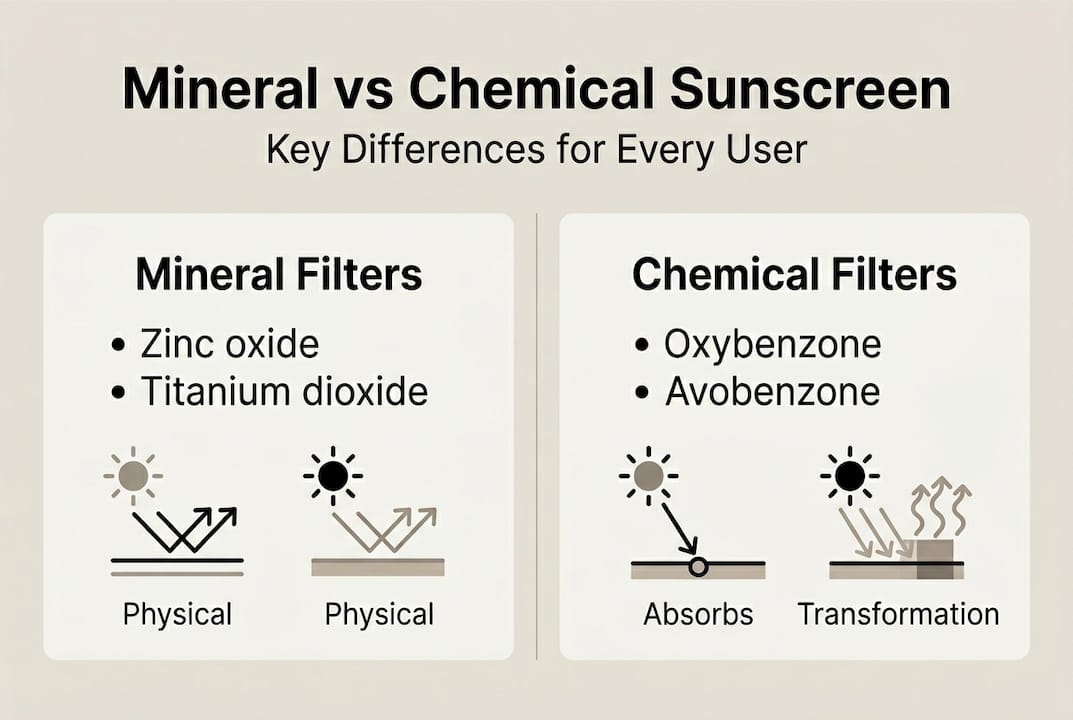
Los protectores solares minerales usan filtros inorgánicos, casi siempre óxido de zinc y dióxido de titanio. Estos se quedan en la superficie de la piel y funcionan sobre todo absorbiendo la radiación UV y convirtiéndola en una pequeña cantidad de calor. La idea de que simplemente “reflejan” los rayos UV como un espejo es en su mayoría un mito. En realidad, los protectores solares minerales absorben el 95% de los rayos UV, y la reflexión y la dispersión representan solo un 4 a 5 por ciento.
Los protectores solares químicos usan filtros orgánicos (a base de carbono) como oxibenzona, avobenzona, octinoxato y octisalato. Estos se absorben en las capas superiores de la piel y funcionan capturando la energía UV y liberándola como calor. No se quedan sobre la piel; actúan dentro de ella.
Aquí tienes una comparación rápida de cómo interactúa cada tipo con tu piel:
- Mineral: Se queda en la superficie de la piel, absorbe y dispersa un poco los rayos UV, y actúa de inmediato al aplicarlo
- Químico: Se absorbe en la piel, convierte los rayos UV en calor, y necesita de 15 a 20 minutos para activarse por completo
- Ambos: Pueden ofrecer protección de amplio espectro eficaz cuando están bien formulados
Amplio espectro significa simplemente que el protector solar protege contra los rayos UVA (que envejecen la piel) y los rayos UVB (que queman). Cualquier SPF 30 o superior etiquetado como amplio espectro cubre ambos.
Para quienes nos importa lo que ponemos en la piel, entender esta diferencia importa. También se relaciona con cómo puedes combinar el protector solar con una base nutritiva, algo que exploramos en nuestra guía sobre sebo vs protectores solares a base de agua.
Comparando ingredientes y seguridad: qué importa más
Entender cómo funcionan es clave, pero la seguridad de los ingredientes y la compatibilidad con la piel importan igual.
Los ingredientes activos de los protectores solares minerales, el óxido de zinc y el dióxido de titanio, tienen un largo historial de seguridad. Cuando se usan en forma no nano, las partículas son lo bastante grandes como para quedarse en la superficie de la piel y no penetrar en las capas más profundas. Las nanopartículas minerales no penetran más allá de la capa superior de la piel, lo cual tranquiliza a quienes tienen piel sensible o reactiva.
Los filtros químicos son un panorama más mixto. Algunos, como la oxibenzona, se absorben de forma sistémica en niveles por encima de los umbrales de la FDA. Los filtros químicos se absorben de forma sistémica, pero no se ha comprobado ningún daño en humanos. Aun así, para quienes prefieren reducir al mínimo lo que absorbe su cuerpo, vale la pena saberlo.
Aquí tienes una comparación de las preocupaciones más comunes:
| Factor | Mineral | Químico |
|---|---|---|
| Penetración en la piel | Se queda en la superficie | Se absorbe en la piel |
| Riesgo de irritación | Menor, perfil más suave | Mayor para piel sensible |
| Preocupación por alteración hormonal | Mínima | Algunos filtros señalados |
| Seguridad para los arrecifes | Generalmente más seguro | Algunos filtros restringidos |
Para las pieles sensibles, las opciones minerales suelen ser la apuesta más segura. También puedes revisar nuestra guía completa sobre ingredientes que debes evitar en el cuidado de la piel para ver con más detalle qué vigilar.
Consejo: Si estás revisando una etiqueta de ingredientes y ves “óxido de zinc” o “dióxido de titanio” en la lista de “Ingredientes activos”, ese es un protector solar mineral. Los filtros químicos aparecen con nombres que terminan en -ona, -ato o -inoxato.
Los beneficios del cuidado natural de la piel de elegir fórmulas más simples van más allá de evitar irritantes. A menudo significan menos ingredientes en total, lo que facilita saber exactamente qué te estás poniendo en la piel.
Rendimiento en la vida real: textura, reaplicación y residuo blanco
Una vez que revisaste los ingredientes, la siguiente preocupación es cómo se siente y funciona el protector solar en el día a día.
Aquí es donde los dos tipos de verdad se diferencian en la experiencia. Los protectores solares minerales, sobre todo los que tienen porcentajes altos de óxido de zinc, tienden a sentirse más espesos y pueden dejar un residuo blanco en tonos de piel más oscuros. Los protectores solares químicos suelen ser ligeros y transparentes, y por eso han dominado el mercado cosmético. Los protectores solares químicos se activan después de 15 a 20 minutos y se sienten casi invisibles en la piel, pero pueden irritar los cutis sensibles o reactivos.

Aquí tienes un desglose práctico por caso de uso:
| Caso de uso | Mejor opción |
|---|---|
| Debajo del maquillaje | Químico (textura más ligera) |
| Niños y piel sensible | Mineral (activos más suaves) |
| Deportes acuáticos | Ambos, si son resistentes al agua |
| Tonos de piel más oscuros | Mineral con color o químico |
Para la reaplicación diaria, sigue estos pasos:
- Aplica el protector solar de 15 a 30 minutos antes de exponerte al sol
- Usa alrededor de una cucharadita para la cara y la cantidad de un caballito para el cuerpo
- Reaplica cada dos horas, o justo después de nadar o sudar
- No te saltes las orejas, la nuca y las manos
Consejo: Un protector solar mineral tipo bálsamo con una base nutritiva, como sebo de res y cera de abeja, puede hacer que reaplicar sea más fácil y agradable. La textura es rica pero no grasosa, y funciona además como un tratamiento para la piel.
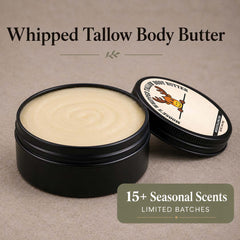
Para quienes están armando una rutina de cuidado con sebo para piel sensible, combinar un protector solar mineral con humectantes a base de sebo crea una rutina simple y compatible, sin acumular muchos productos sintéticos.
Cómo elegir el protector solar adecuado para tus valores y necesidades
Ahora hagamos prácticos esos datos, con un marco que te ayude a elegir con confianza según tu piel y tus preferencias.
Empieza por tus valores. Si evitar los químicos sintéticos es importante para ti, el mineral es la opción clara. El mineral encaja con las preferencias naturales, y el mejor protector solar siempre es el que de verdad vas a usar con constancia.
Aquí tienes un flujo de decisión simple:
- ¿Piel sensible o reactiva? Elige mineral.
- ¿Prefieres un acabado ligero e invisible? El químico puede irte mejor.
- ¿Te preocupa la absorción sistémica? Elige mineral con óxido de zinc no nano.
- ¿Lo usarás en niños? El mineral es la opción más suave y confiable.
- ¿Priorizas ingredientes limpios y simples? Lee la etiqueta completa, no solo el frente.
Ese último punto importa más de lo que la mayoría cree. Algunos protectores solares “solo minerales” contienen químicos extra que absorben UV para mejorar la textura o el SPF, pero no los listan como activos. Alrededor de un tercio de los productos que se venden como solo minerales entran en esta categoría.
Cuidado con estas trampas comunes de las etiquetas:
- “Natural” no significa mineral ni libre de químicos
- Los números de SPF por encima de 50 ofrecen muy poca protección adicional
- “Resistente al agua” no significa impermeable; igual hay que reaplicar
Entender qué hace que el cuidado de la piel sea natural ayuda a filtrar el ruido del marketing. Y si quieres una lista de verificación para guiar tu próxima compra, nuestra guía sobre cuidado natural de la piel seguro es un buen punto de partida.
Lo que la mayoría de las guías pasan por alto al elegir protector solar
Hay algo que creo que se pierde en todos los debates sobre ingredientes: el hábito de protección solar más saludable no se trata de encontrar la fórmula más “pura”. Se trata de encontrar una que de verdad tomes cada mañana sin pensarlo dos veces.
Hemos visto a personas gastar tanta energía comparando etiquetas que terminan sin usar nada de forma constante. Eso es una verdadera pérdida. La comodidad en la piel, la textura e incluso el aroma importan, porque determinan si vas a seguir usándolo. Elegir sebo para piel sensible es un ejemplo de dejar que la sensación real guíe tu rutina, no solo la teoría. Los estudios también lo respaldan. El uso constante de cualquier SPF 30 o superior de amplio espectro y bien formulado protege mucho mejor que el uso ocasional de una fórmula “perfecta”.
Opciones de protección solar natural y segura en las que puedes confiar
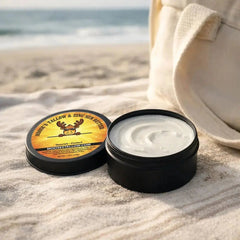
Si has estado buscando un protector solar mineral que de verdad se sienta bien al usarlo, vale la pena mirar de cerca nuestro bálsamo solar de sebo con zinc. Está hecho alrededor de óxido de zinc no nano para protección de amplio espectro, con sebo de res para una nutrición profunda y cera de abeja y alcohol cetílico para que dure. Sin rellenos innecesarios. Sin filtros químicos sintéticos. Solo una fórmula limpia y eficaz que trabaja con la biología natural de tu piel. Explora toda nuestra gama de productos de cuidado de la piel totalmente naturales para encontrar opciones que encajen en tu rutina diaria.
Preguntas frecuentes
¿Los protectores solares minerales de verdad solo reflejan la luz del sol?
No. Los protectores solares minerales absorben el 95% de los rayos UV y solo reflejan o dispersan un 4 a 5 por ciento, así que la absorción es el mecanismo principal, no la reflexión.
¿Los protectores solares químicos son seguros para uso diario?
La mayoría se consideran seguros para uso diario. Los filtros químicos se absorben de forma sistémica por encima de los umbrales de la FDA.
¿Qué protector solar es mejor para la piel sensible?
Los protectores solares minerales suelen ser la opción más suave, con menos químicos orgánicos y un menor riesgo de irritación para las pieles reactivas o sensibles.
¿Qué importa más para la protección, el SPF o el tipo de protector solar?
La constancia es lo que más importa. La mejor opción es la que usas todos los días con SPF 30 o superior y cobertura de amplio espectro.
¿Los protectores solares “solo minerales” siempre están libres de filtros químicos?
No siempre. El 34% de los protectores solares “solo minerales” contienen químicos que absorben UV no declarados, añadidos para textura o SPF, pero no listados como ingredientes activos.
Recomendado
- Bálsamo Solar de Sebo con Zinc – Protección UV Mineral Natural – Moose’s Tallow
- Sebo vs protectores solares a base de agua: lo que tu piel necesita – Moose’s Tallow
- Sebo vs aceites vegetales: 22% más hidratación para tu piel – Moose’s Tallow
- Magnesio vs melatonina para dormir: cuál te conviene – Moose’s Tallow


0 comentarios