

Vitamins A, C, and E are the ones that matter most for dry, sensitive skin. Vitamins A and E are fat-soluble, so they integrate naturally into lipid-rich, water-free formulas. Vitamin C supports barrier lipids and collagen pathways, though it needs careful formulation in anhydrous products. For a tallow-based routine, prioritize products that list vitamin E (tocopherols) in the ingredient panel, paired with beef suet tallow and fractionated coconut oil.
What to look for in a tallow product:
- Vitamin E (tocopherols) listed as an ingredient, not just implied
- Fractionated coconut oil as the carrier for stability and clean absorption
- Beeswax for structure in balms and butters
- No water as the first ingredient
- A short, transparent ingredient list with no fillers
A systematic review on vitamins and skin health confirms that vitamins A, C, and E support barrier integrity, antioxidant defense, and immune modulation. Tallow itself contains modest natural levels of fat-soluble vitamins, but its real value is its fatty-acid profile, which mirrors your skin’s own oils. The vitamins you want are the ones deliberately added to the formula.
How do vitamins support your skin barrier?
Vitamins support barrier structure, antioxidant defense, and immune modulation. Those are three distinct jobs, and each one matters for dry or sensitive skin.
“Micronutrients, including vitamins and minerals, are not only essential components of skin structure, but they also modulate multiple biological functions.” — PMC review on micronutrients and skin
Antioxidant defense is the most direct role. Free radicals from UV exposure and pollution damage the lipids and proteins in your stratum corneum. Vitamins neutralize those radicals before they break down your barrier. Fat-soluble vitamins also help preserve the lipid matrix in your skin’s outer layers, which reduces transepidermal water loss (TEWL). Less water escaping means skin stays softer and more comfortable. Certain vitamins also influence your skin’s innate defenses and microbial balance, which is why barrier support and immune modulation are often discussed together in skin research.
Tallow fits into this picture because its fatty acids, particularly palmitic, stearic, and oleic acids, mirror human skin lipids. Vitamins carried in a lipid matrix are more likely to integrate with your skin’s own structure. That is the practical case for vitamin-enriched, water-free tallow formulas.
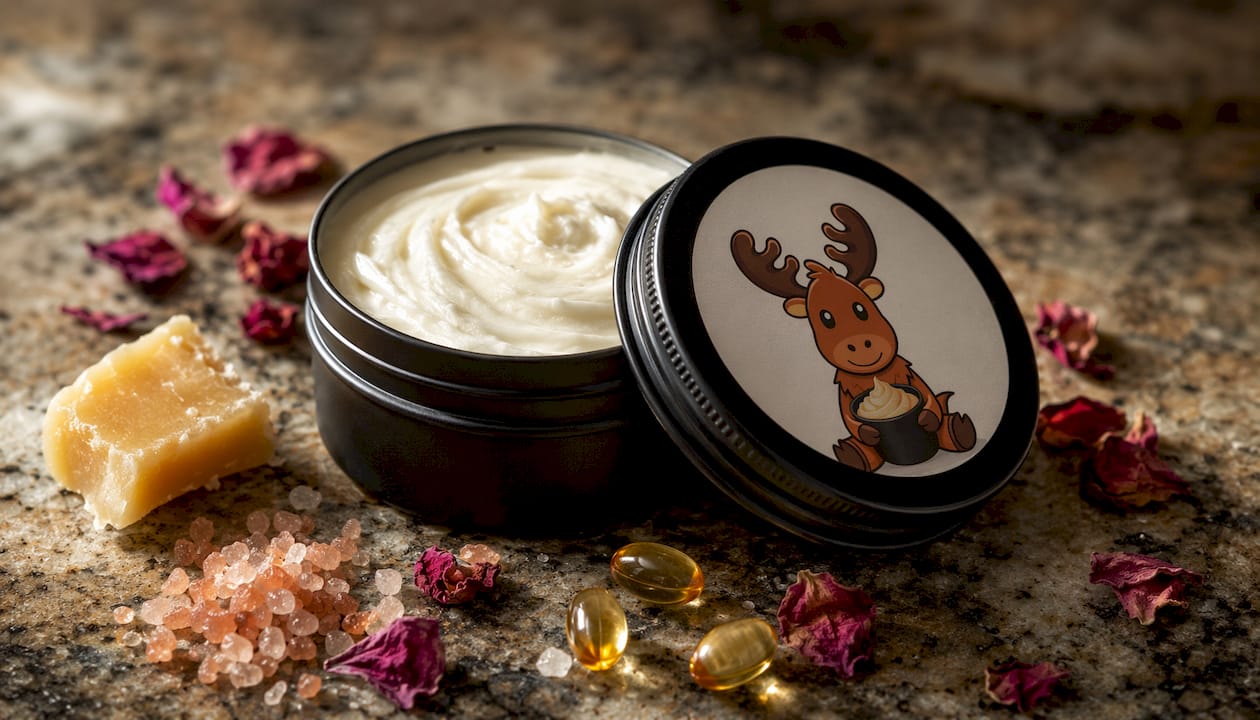
Which vitamins matter most: A, C, and E in tallow formulas
| Vitamin | Primary skin role | Fat-soluble? | Fits anhydrous tallow? | Sensitization risk |
|---|---|---|---|---|
| A (retinol/esters) | Barrier support, keratinocyte regulation | Yes | Yes, at low cosmetic doses | Low to moderate |
| C (ascorbic acid/esters) | Collagen cofactor, ceramide support | No (water-soluble) | Only as oil-soluble ester | Low |
| E (tocopherols) | Antioxidant, lipid membrane protection | Yes | Yes, excellent fit | Very low |
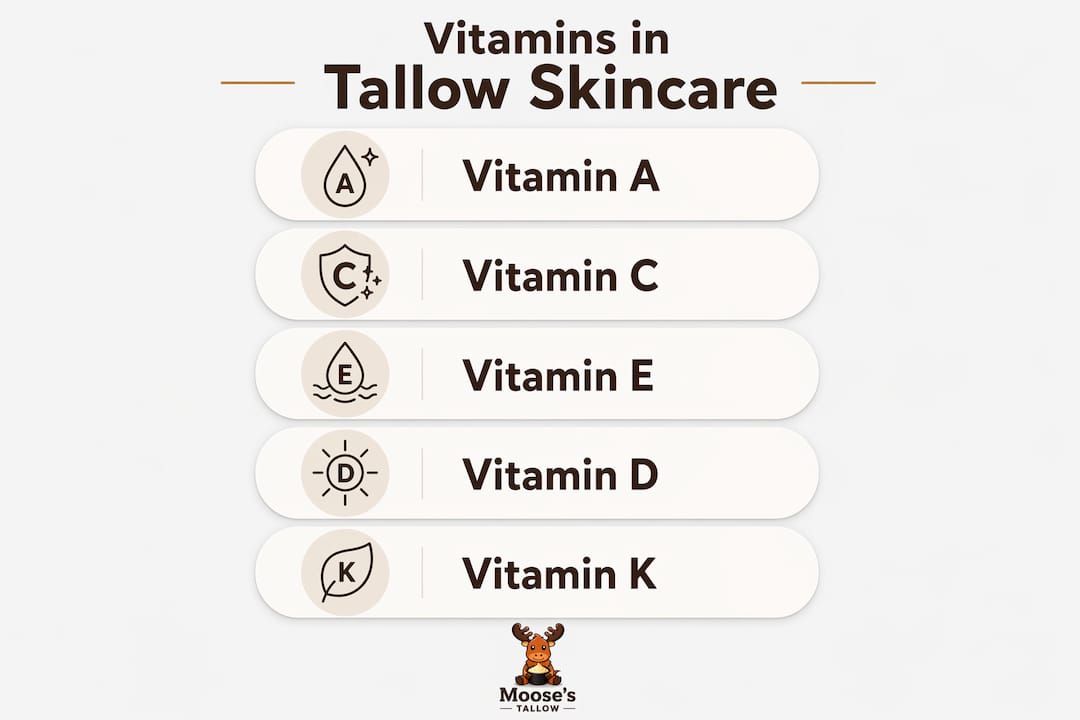
Vitamin A supports keratinocyte turnover and barrier structure. In a tallow or oil formula, it works at cosmetic concentrations, not the prescription-strength retinoid level. Oil delivery helps it stay stable and reduces the irritation risk that comes with higher-concentration retinoid products.
Vitamin C is a collagen cofactor and supports ceramide regulation. The challenge is that standard ascorbic acid is water-soluble and unstable in anhydrous formulas. Formulators handle this with oil-soluble esters like ascorbyl tetraisopalmitate, which can be incorporated into lipid-based products. For purely water-free tallow balms, vitamin C is the hardest of the three to include effectively.
Vitamin E (tocopherols) is the clearest fit for tallow-based products. It is fat-soluble, integrates into lipid membranes, and accumulates in the stratum corneum to reduce UV and free-radical damage. It also stabilizes the formula itself, slowing oxidation of the carrier oils. For general barrier support, vitamin E is the one to prioritize in any anhydrous tallow product.
How water-free tallow formulas stay stable
Water-free tallow products rely on stable, low-oxidation carriers and antioxidants to stay safe and effective. Without water, there is no hydrolytic breakdown, but oxidation of the oils is still a real concern.
Pro Tip: Store tallow balms and butters away from heat and direct light. Choose products in opaque, tight-seal containers. Heat and UV exposure accelerate oxidation even in anhydrous formulas.
Key formulation controls in a well-made tallow product:
- Fractionated coconut oil as the primary carrier: it resists oxidation, absorbs cleanly, and extends shelf life compared with less stable oils
- Vitamin E (tocopherols) added as an in-formula antioxidant, not just a skin ingredient
- Beeswax for structure in balms, which also limits surface exposure to air
- Airtight, opaque packaging to reduce light and oxygen contact
Small-batch production matters here. Shorter production runs mean fresher product with less time for oxidation to build. Formulation best practices point to fractionated coconut oil and tocopherols as the standard combination for anhydrous oil-based products. That is exactly the approach Moose’s Tallow uses.
How to apply vitamin-enriched tallow products for dry, sensitive skin
- Patch test first. Apply a small amount to your inner forearm. Wait 24 hours. Look for redness, stinging, or persistent irritation before using on your face or a larger area.
- Apply to damp skin. After washing, leave skin slightly damp. Tallow balms work as an occlusive layer, trapping moisture already present.
- Warm the product in your hands. A small amount goes a long way. Rub between palms for a few seconds before applying.
- Apply a thin layer. Face, hands, lips, beard area, or body as needed. Thin layers absorb better than thick ones.
- Layer correctly if using serums. Apply any water-based serum first. Then apply tallow as the final occlusive step.
- Daytime vs. nighttime. A lighter application works for daytime. At night, you can use a slightly more generous layer on very dry areas.
- Avoid thick application on acne-prone zones. Use sparingly on the facial T-zone if you tend toward oiliness there.
For a full step-by-step routine built around tallow, the tallow skincare routine for sensitive skin guide walks through every step.
Safety and sensitivity: what to watch for
Most people with dry, sensitive skin tolerate tallow with vitamin E well, but patch testing is not optional. It is the first step every time you try a new product.
Fragrance and essential oils are the most common sensitization triggers in natural skincare. If your skin is reactive, choose fragrance-free formulas first.
Watch for these signals during a patch test: redness that does not fade within an hour, stinging that persists, or any worsening of existing irritation. If any of those appear, discontinue use. For babies, a pediatrician check before introducing any new topical product is a reasonable precaution, even with simple, clean formulas. For pets, Moose’s Tallow’s Puppy Paw Nourishing Balm is formulated specifically for animals, so use pet-specific products rather than repurposing human skincare.
Fragrance-free options are the right starting point for sensitive skin. Essential oils, even natural ones, can raise sensitization risk with repeated use.
Why tallow and vitamin E work well together
“Beef tallow does indeed contain saturated and unsaturated fats — like palmitic acid, stearic acid, and oleic acid — which are naturally found in human skin and could make for an effective barrier repair product.” — National Geographic
Moose’s Tallow formulates with grass-fed, locally rendered beef suet tallow, fractionated coconut oil, beeswax, and vitamin E for both barrier support and formula stability. Every ingredient is on the label. Nothing is hidden, and nothing is filler.
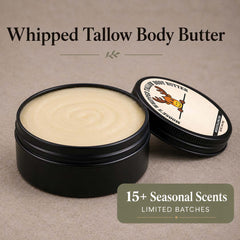
Brian Smith started Moose’s Tallow in Lebanon, PA, after reading the label on his own lotion. Fifty-two ingredients, and the first was water. He wanted something simpler. The result is a line of handmade, small-batch products built around a short, honest ingredient list. Two products that show this clearly: the Whipped Tallow Body Butter, which uses tallow, fractionated coconut oil, and vitamin E for full-body barrier support, and the Beef Tallow Lip Balm, which adds beeswax for structure on lips. Both are water-free. Both list every ingredient. Every order ships across the U.S. and is backed by a 60-day guarantee.
Other vitamins that benefit skin: D, K, and B-complex
Beyond A, C, and E, several other vitamins play meaningful roles in skin health.
Vitamin D is synthesized in skin following UVB exposure and supports innate immunity by stimulating antimicrobial peptide production. It also modulates inflammation and supports wound healing. Low vitamin D levels have been associated with more severe atopic dermatitis in some studies.
Vitamin K supports skin’s ability to manage bruising and dark circles. A topical gel combining phytonadione (vitamin K), retinol, vitamin C, and vitamin E has shown some benefit for under-eye dark circles related to hemostasis, according to published dermatology research.
Vitamin B3 (niacinamide) is water-soluble and one of the most studied vitamins in cosmetics. It penetrates the stratum corneum, supports DNA repair and energy metabolism in skin cells, and has anti-inflammatory and antibacterial properties. It is widely used in dermo-cosmetics for acne, rosacea, and barrier support.
Vitamin B12 has a negative relationship with certain inflammatory markers and has been studied in the context of vitiligo and eczema.
Vitamin B2 (riboflavin) helps block NF-kB activation, an anti-inflammatory pathway relevant to skin immunity.
In tallow-based, water-free formulas, fat-soluble vitamins (A, D, E, K) are the practical choices. Water-soluble B vitamins require either a water phase or specialized delivery to be effective topically.
How tallow delivers vitamins differently than other carriers
Tallow’s fatty-acid profile, rich in palmitic, stearic, and oleic acids, closely mirrors human sebum. That structural similarity means tallow can integrate into the skin’s lipid matrix more readily than many plant-based oils. Fatty acids and triglycerides act as vehicles that enhance uptake of other compounds into keratinocytes, so fat-soluble vitamins carried in tallow have a compatible pathway into skin.
Compared with water-based lotions, tallow delivers vitamins without dilution. A water-first lotion spreads active ingredients across a large water phase, reducing the concentration that actually contacts skin. A water-free tallow formula keeps the vitamin in a concentrated lipid environment from the moment it touches your skin.
Fractionated coconut oil, Moose’s Tallow’s preferred carrier, adds another layer of stability. It resists oxidation better than many vegetable oils, which means the vitamin E and other fat-soluble actives in the formula stay effective longer. For readers comparing options, the tallow vs. plant oils hydration comparison covers the lipid-compatibility difference in more detail.
What concentration of vitamins works in tallow-based products?
Cosmetic vitamin E (tocopherols) is typically used at 0.5%–1% in over-the-counter skincare products. At that range, it functions both as an antioxidant for the formula and as a skin-supportive ingredient. Going higher does not always mean better results, and very high concentrations can occasionally cause contact sensitivity.
Vitamin A in cosmetic (non-prescription) products is generally used at low concentrations. Retinoid-strength effects require prescription-level doses. Cosmetic vitamin A in an oil formula supports barrier function without the irritation risk of high-dose retinoids.
Tallow itself contains modest natural amounts of fat-soluble vitamins, but not at concentrations that would deliver targeted cosmetic effects on their own. The vitamins that matter are the ones intentionally added to the formula at effective cosmetic concentrations. That is why ingredient transparency matters: you want to see vitamin E listed, not just implied by the presence of tallow.
How to identify a high-quality vitamin-enriched tallow product
A good tallow product is easy to read. The ingredient list is short. Tallow is first or second. Vitamin E (tocopherols) appears by name. The carrier oil is stable, fractionated coconut oil being the clearest signal of a formulator who understands oxidation. Beeswax in a balm adds structure without synthetic thickeners.
Red flags: a long ingredient list with multiple fillers, water listed first, fragrance listed without specifics, or no ingredient list at all. Grass-fed sourcing and small-batch production are meaningful quality signals because they indicate the producer controls the supply chain and the batch size. A 60-day guarantee is a practical trust signal: the brand stands behind what it makes.
For a structured checklist, the tallow product checklist covers every criterion worth checking before you buy.
How vitamins interact with other ingredients in tallow-based products
Vitamin E and vitamin C have a well-documented synergistic relationship. Together, they provide greater antioxidant protection than either alone. In a water-free formula, pairing a stable vitamin C ester with vitamin E tocopherols is a sound formulation strategy.
Vitamin E also interacts positively with beeswax. Beeswax limits oxygen exposure at the product surface, which slows the oxidation that vitamin E is working to prevent. The two work in the same direction.
Egg yolk infused oil, used in some Moose’s Tallow formulas, contributes naturally occurring fat-soluble nutrients and lecithin, which supports emulsification and skin feel. It is a complementary ingredient, not a competing one.
One interaction to be aware of: vitamin A and vitamin E can compete for absorption at very high concentrations in oral supplementation. In topical cosmetic use at typical concentrations, this is not a practical concern. Jojoba and castor, both used in Moose’s Tallow formulas, are stable and do not interfere with vitamin activity at cosmetic concentrations.
Key Takeaways
Fat-soluble vitamins A and E integrate directly into tallow’s lipid matrix, making them the most practical choices for water-free, anhydrous skincare formulas.
| Point | Details |
|---|---|
| Prioritize vitamins A and E | Both are fat-soluble and integrate cleanly into tallow and fractionated coconut oil formulas. |
| Vitamin E does double duty | It supports skin antioxidant defense and stabilizes the formula itself against oxidation. |
| Patch test every new product | Apply to inner forearm, wait 24 hours, and check for redness or stinging before full use. |
| Choose fragrance-free for sensitivity | Fragrance and essential oils are the most common sensitization triggers in natural skincare. |
| Moose’s Tallow uses vitamin E by design | Every formula lists tocopherols explicitly, paired with grass-fed tallow and fractionated coconut oil. |
Why simple ingredient lists are the honest answer
People ask me why I keep the ingredient lists so short. The honest answer is that I started this because I flipped over my own lotion bottle and counted 52 ingredients. Water was first. I did not know what most of the others were. That bothered me.
Skin does not need complexity. It needs the right things in the right amounts. Tallow’s fatty acids are close to what your skin already produces. Vitamin E belongs there because it protects both the formula and your skin. Fractionated coconut oil belongs there because it is stable and absorbs cleanly. Beeswax belongs there because it gives structure without synthetic thickeners. Every other ingredient in a Moose’s Tallow product is there for a specific reason, and you can read exactly what it is on the label.
The 60-day guarantee exists because I want you to try it without risk. If it does not work for your skin, send it back. That is the commitment.
Moose’s Tallow products with vitamin E for your routine
Dry, sensitive skin deserves a short ingredient list and a formula that actually stays on your skin. Moose’s Tallow builds every product around grass-fed beef suet tallow, fractionated coconut oil, and vitamin E (tocopherols), handmade in small batches in Lebanon, PA, and shipped across the U.S.
| Beef Tallow Lip Balm | Whipped Tallow Body Butter | |
|---|---|---|
| Best for | Dry, chapped lips | Dry or sensitive body skin |
| Tallow compatibility | Excellent | Excellent |
| Anhydrous stability | High (beeswax structure) | High (fractionated coconut oil base) |
| Typical use area | Lips | Face, body, hands |
| Sensitization risk | Very low | Very low |
Both products list every ingredient. Both are water-free. Both contain vitamin E by name. The lip balm adds beeswax for firm structure suited to lip application. The body butter whips to a lighter texture for larger areas. Browse the full product line to find the right fit for your routine. Every order is backed by a 60-day guarantee.
FAQ
What vitamins work best in water-free tallow skincare?
Vitamins A and E are the best fit because they are fat-soluble and integrate directly into tallow’s lipid matrix. Vitamin E (tocopherols) is the top priority for both skin antioxidant support and formula stability.
Does tallow naturally contain vitamins?
Tallow contains modest natural amounts of fat-soluble vitamins A, D, E, and K, but not at concentrations that deliver targeted cosmetic effects. The vitamins that matter most are the ones intentionally added to the formula.
How does vitamin E help in an anhydrous tallow formula?
Vitamin E acts as both a skin antioxidant and an in-formula preservative, slowing oxidation of the carrier oils and extending the product’s usable life.
Is vitamin C effective in tallow-based, water-free products?
Standard ascorbic acid is water-soluble and unstable in anhydrous formulas. Oil-soluble vitamin C esters can be used, but vitamin C is the most formulation-challenging of the three key vitamins in a purely water-free product.
How do I know if a tallow product has enough vitamin E?
Look for “tocopherol” or “tocopherols” listed by name in the ingredient panel. Cosmetic products typically use vitamin E at 0.5%–1%; if it appears on the label, it is present at a meaningful level.


0 comments