

Topical treatment is the direct application of a substance to a body surface, such as the skin, eyes, or mucous membranes, to produce a localized effect. The global topical drug delivery market reached $102.3 billion in 2024, which tells you how central this delivery method has become to modern skin care. Formulations range from creams and ointments to gels and balms, each designed to carry active ingredients to where they are needed without flooding the rest of your body. Understanding how these formulations differ, and how to apply them correctly, makes a real difference in how well they work.
What is topical treatment and how does it work?
Topical treatment delivers active ingredients directly to the skin or another surface tissue. The goal is a localized effect, meaning the ingredient works where you put it rather than circulating through your bloodstream. This is what separates topical therapy from oral medications, which must pass through the digestive system before reaching the skin.
Every topical product has two parts: the active ingredient and the vehicle. The vehicle is the base that carries the active ingredient. It controls how fast the ingredient absorbs, how the product feels, and whether it suits your skin type. Experts at the Merck Manuals note that the vehicle is part of the prescription, not just packaging. That framing matters because most people focus only on the active ingredient and ignore the base entirely.
Topical therapy also bypasses first-pass metabolism. When you swallow a medication, your liver processes it before it reaches your target tissue. A topical product skips that step entirely. The result is more direct delivery with less systemic exposure, which is why topical options are often preferred for skin conditions, mild irritation, and daily skin care.
What types of topical treatments are available?
Different formulation types suit different skin conditions and needs. Choosing the wrong one can reduce effectiveness or cause new problems.
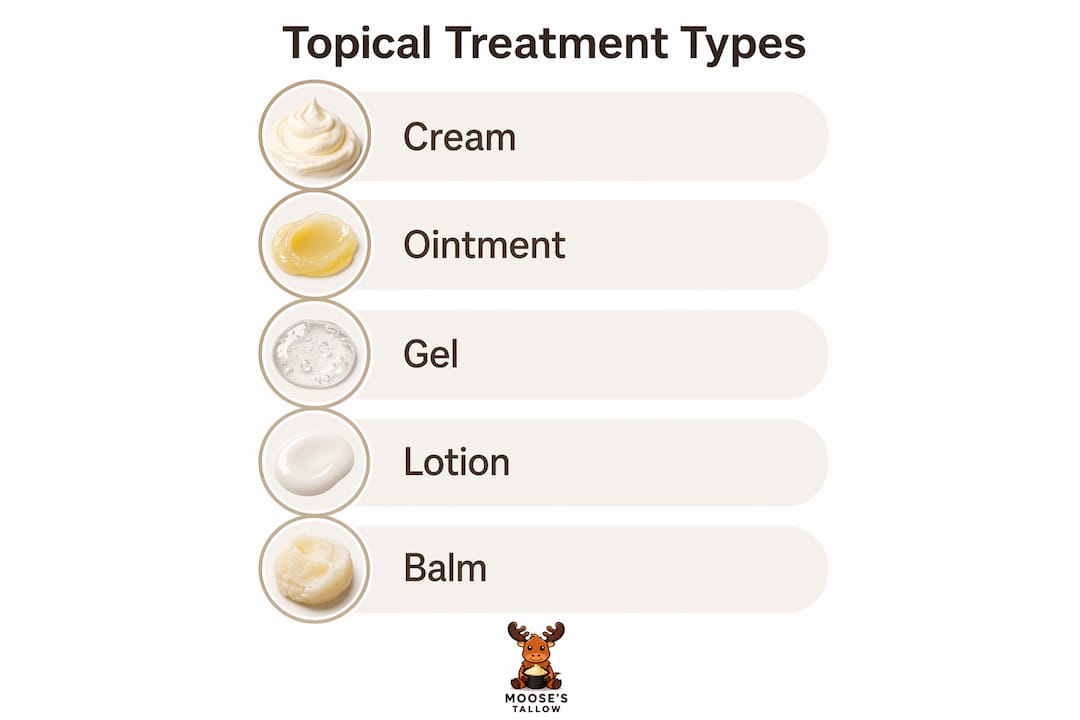
Here is a breakdown of the most common types:
- Creams are oil-in-water emulsions. They spread easily, absorb quickly, and feel light on the skin. They work well for most skin types and are the most widely used formulation.
- Ointments are oil-based and occlusive. They create a barrier over the skin that locks in moisture. They suit very dry or cracked skin but can feel greasy and may clog pores on oily skin.
- Gels are water-based and often contain alcohol. They feel cooling and absorb fast. They work well for oily or acne-prone skin.
- Lotions are lighter than creams and spread easily over large areas. They suit normal to slightly dry skin.
- Balms are dense, wax-based formulations. They protect and condition without water. They are ideal for lips, hands, and areas exposed to the elements.
- Sprays and foams offer easy application over large or hard-to-reach areas. They suit scalp treatments and body applications.
| Formulation | Base type | Best for | Feel |
|---|---|---|---|
| Cream | Oil-water emulsion | Most skin types | Light, non-greasy |
| Ointment | Oil base | Very dry or cracked skin | Heavy, occlusive |
| Gel | Water or alcohol base | Oily or acne-prone skin | Cooling, fast-absorbing |
| Lotion | Light emulsion | Normal to slightly dry skin | Thin, easy to spread |
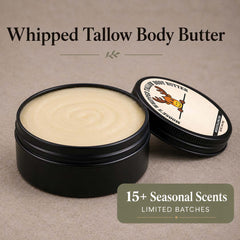
| Balm | Wax or tallow base | Lips, hands, exposed areas | Rich, protective |
The vehicle governs absorption and skin compatibility as much as the active ingredient does. A heavy ointment on oily skin can clog pores even when the active ingredient targets a legitimate concern. Matching the formulation to your skin type is not optional. It is the foundation of effective topical therapy.
How do topical treatments benefit your skin?
The primary benefit of topical treatment is targeted delivery. You apply it where you need it, and the active ingredient works there. This minimizes the risk of systemic side effects that come with oral medications.
Topical treatments also support the skin barrier directly. The skin barrier is the outermost layer of the skin. It keeps moisture in and irritants out. When it is compromised, skin becomes dry, tight, and reactive. Formulations built on ingredients like beef suet tallow work with the skin’s natural fatty-acid profile. Tallow is always the star in Moose’s Tallow products because its lipid composition closely mirrors the skin’s own oils, which supports barrier function without disrupting it.
Fractionated coconut oil is the preferred carrier oil at Moose’s Tallow because it is stable, resists oxidation, absorbs easily, and has a long shelf life. This matters because carrier oil stability directly affects how long a product performs and how well it delivers its active ingredients. Unstable oils go rancid and can irritate skin rather than help it.
The benefits of topical therapy include:
- Localized action with minimal systemic exposure
- Direct support for the skin barrier
- Faster onset compared to oral routes for skin concerns
- Flexibility in formulation to match skin type and condition
- Ability to combine multiple active ingredients in one application
Pro Tip: Apply emollients and balms to slightly damp skin. Damp skin absorbs moisture-locking ingredients more effectively than completely dry skin, which means you get more from less product.
What are common topical treatment options for skin care?
Over-the-counter topical options cover a wide range of skin concerns. A 2025 study showed that daily oatmeal lotion use improved symptoms in people with sensitive skin and mild psoriasis. That result reflects how effective simple, well-formulated topical products can be for mild conditions.
Common topical treatment categories include:
- Moisturizers and emollients: Creams, balms, and butters that restore and maintain the skin barrier. Ingredients like beef suet tallow, beeswax, and vitamin E (tocopherols) fall here.
- Anti-itch formulations: Products containing colloidal oatmeal or similar soothing agents that calm irritated skin.
- Soothing cosmeceuticals: Research shows that adjunctive soothing skincare reduces side effects from stronger treatments and improves compliance. These products sit between cosmetics and pharmaceuticals in terms of active ingredient concentration.
- Mineral-based protectants: Zinc oxide is a common example. It sits on the skin surface and reflects UV rays or soothes irritation without penetrating deeply.
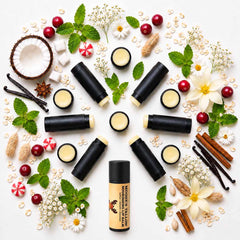
- Natural ingredient formulations: Products built on tallow, fractionated coconut oil, jojoba, castor, and egg yolk infused oil. These focus on ingredient transparency and minimal dilution.
One thing worth knowing: consumers often confuse the regulatory categories of drugs and cosmetics. A product labeled as a cosmetic is not held to the same clinical evidence standard as a drug. Understanding that distinction helps you read labels more critically. For a broader look at how cosmetics are classified and regulated, the J&J Consulting Group’s cosmetics guide offers a clear breakdown.
Witch hazel appears in many natural topical products, but it can cause irritation for people with sensitive skin when used in high concentrations. Always check the full ingredient list, not just the featured actives. Knowing which ingredients to avoid is as important as knowing which ones to seek out. A good starting point is reviewing ingredients to avoid in skincare before committing to a new product.
How to apply topical treatments correctly
Correct application determines whether a topical product works or causes problems. More product does not mean better results. Overuse raises irritation risk without improving efficacy. Thin, even layers are always the right approach.
Follow these steps for safe and effective application:
- Clean the area first. Wash the skin gently with water or a mild cleanser. Pat dry, but leave the skin slightly damp if you are applying a moisturizing balm or emollient.
- Patch test new products. Apply a small amount to the inside of your wrist or elbow. Wait 24 hours before applying to a larger area. This is especially important for people with sensitive skin.
- Apply a thin layer. Use fingertips or a clean applicator. Spread the product evenly without rubbing aggressively. Gentle application preserves the skin barrier.
- Avoid broken or inflamed skin. Applying to broken skin increases systemic absorption risk. If the skin is cracked or open, consult a healthcare provider before using any active topical.
- Do not mix incompatible products. Layering multiple active topicals can cause irritation or reduce effectiveness. If you use more than one product, apply the lightest formulation first and allow it to absorb before adding the next.
- Watch for irritation signs. Redness, stinging, or increased dryness after application signals a problem. Stop use and reassess the product or your application method.
Pro Tip: Gentle application is not just about comfort. Scrubbing or rubbing a topical product into the skin can disrupt the barrier you are trying to support. Use light, circular motions and let the formulation do the work.
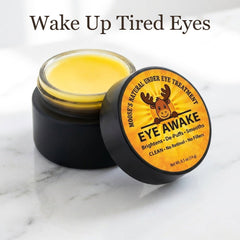
For a detailed walkthrough of correct application technique in a specific context, the step-by-step under-eye cream guide from Moose’s Tallow applies the same principles to a delicate skin area.
Key Takeaways
Topical treatment works best when the formulation, active ingredients, and application method are matched to your specific skin type and condition.
| Point | Details |
|---|---|
| Vehicle matters as much as actives | The base formulation controls absorption, skin feel, and compatibility. |
| Match formulation to skin type | Ointments suit dry skin; gels suit oily skin; balms protect exposed areas. |
| Apply thin layers to damp skin | Thin application reduces irritation; damp skin improves moisture retention. |
| Patch test before full use | Testing on a small area first prevents reactions on sensitive skin. |
| Ingredient transparency builds trust | Fewer, intentional ingredients reduce the risk of irritation and filler exposure. |
What I have learned from years of building topical formulations
When I started Moose’s Tallow, I looked at my lotion label and counted 52 ingredients. Water was first. That told me everything I needed to know about how most topical products are built. They are diluted down to the point where the active ingredients barely have room to work.
The most common mistake I see is people chasing active ingredients while ignoring the vehicle. You can have the best active in the world, but if it is sitting in a base that does not suit your skin, you will not get the result you want. Worse, you might get a reaction. I have seen people with dry, sensitive skin reach for gel-based products because they sound “lighter,” only to end up with more irritation. The formulation has to match the skin.
Natural does not automatically mean safe, and synthetic does not automatically mean harmful. Witch hazel is natural. It also irritates a lot of people. What matters is whether each ingredient has a purpose and whether the concentration is appropriate. At Moose’s Tallow, every ingredient earns its place. We do not add water to bulk up a formula. We do not add fragrance to mask a smell. What you see on the label is what is doing the work.
My honest advice: read the full ingredient list, not just the front of the label. Understand what the vehicle is. Patch test anything new. And if a product has 40 ingredients, ask yourself how many of them are actually doing something for your skin.
— Brian Smith
Tallow-based topical care from Moose’s Tallow
Moose’s Tallow builds every product on properly rendered beef suet tallow, fractionated coconut oil, beeswax, vitamin E (tocopherols), jojoba, castor, and egg yolk infused oil. Every formula is water-free and made in small batches in Lebanon, PA. If you have dry, tight, or sensitive skin and you are tired of products full of fillers, these are worth a look.
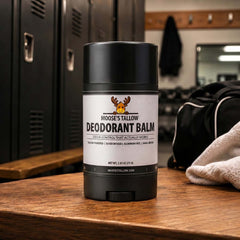
The beef tallow lip balm is a good starting point for anyone new to tallow-based topical care. For outdoor use, the zinc sun balm combines beef tallow with mineral zinc oxide for natural UV protection. The tallow deodorant balm is formulated for sensitive underarm skin. All products are backed by a 60-day guarantee.
FAQ
What is topical treatment in simple terms?
Topical treatment is any product applied directly to the skin or mucous membranes to produce a localized effect. It includes creams, ointments, gels, balms, and lotions used for skin care or mild skin concerns.
What are the main types of topical treatments?
The main types are creams, ointments, gels, lotions, and balms. Each has a different base that affects how it absorbs, how it feels, and which skin types it suits best.
Is topical treatment effective for sensitive skin?
Topical treatment is effective for sensitive skin when the formulation matches the skin type and the ingredient list is minimal and intentional. Patch testing before full application reduces the risk of reactions.
How does topical treatment differ from oral medication?
Topical treatment delivers active ingredients directly to the skin without passing through the digestive system. This produces a localized effect and reduces systemic exposure compared to oral medications.
How much topical product should I apply?
A thin, even layer is always enough. Applying more product does not increase effectiveness and raises the risk of irritation, according to topical medication administration guidelines.


0 comments