

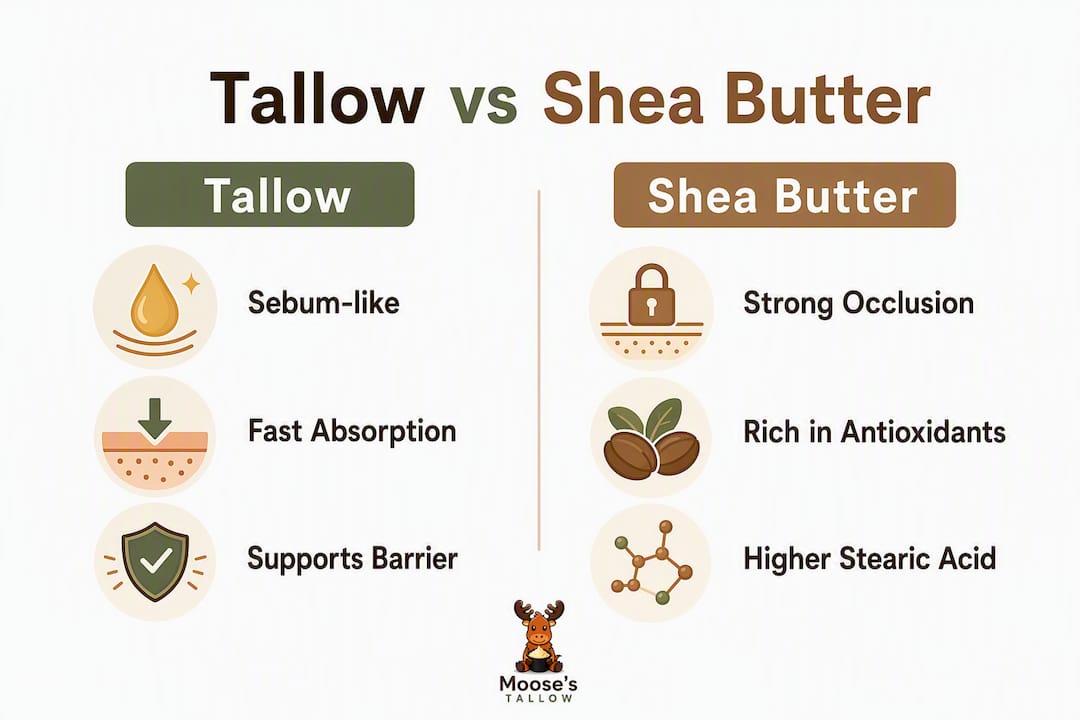
For skin-barrier support and clean absorption, tallow is the better pick for most people who are open to animal-derived ingredients. Shea butter is a solid plant-based occlusive, but its fatty-acid profile does not mirror human sebum the way beef suet tallow does. That single difference drives most of what follows.
Here is the quick version:
- Absorption: Tallow’s palmitic and oleic acids closely match your skin’s own sebum, so it tends to absorb more cleanly and feel less heavy on the face.
- Occlusion: Shea butter’s high stearic acid content makes it a firmer, more surface-sitting occlusive. Strong for locking in moisture on the body; less ideal for daily facial use.
- Texture: Tallow melts into skin. Shea can leave a waxy, slightly greasy film, especially in cooler temperatures.
- Ethics: Shea is plant-derived and vegan. Tallow is animal-derived. That matters to some buyers and is worth knowing up front.
- Moose’s Tallow builds every product around properly rendered local beef suet tallow, not shea butter. The reason is straightforward: tallow is always the star because it works like skin.
What are tallow and shea butter, and how is each made?
Beef suet tallow comes from the fat surrounding the kidneys and loins of cattle. Rendering means slowly heating that raw suet to separate the pure fat from connective tissue and moisture. Done well, the result is a clean, stable fat with a long shelf life. Done poorly, it smells and oxidizes fast. Small-batch, properly rendered suet is the difference.
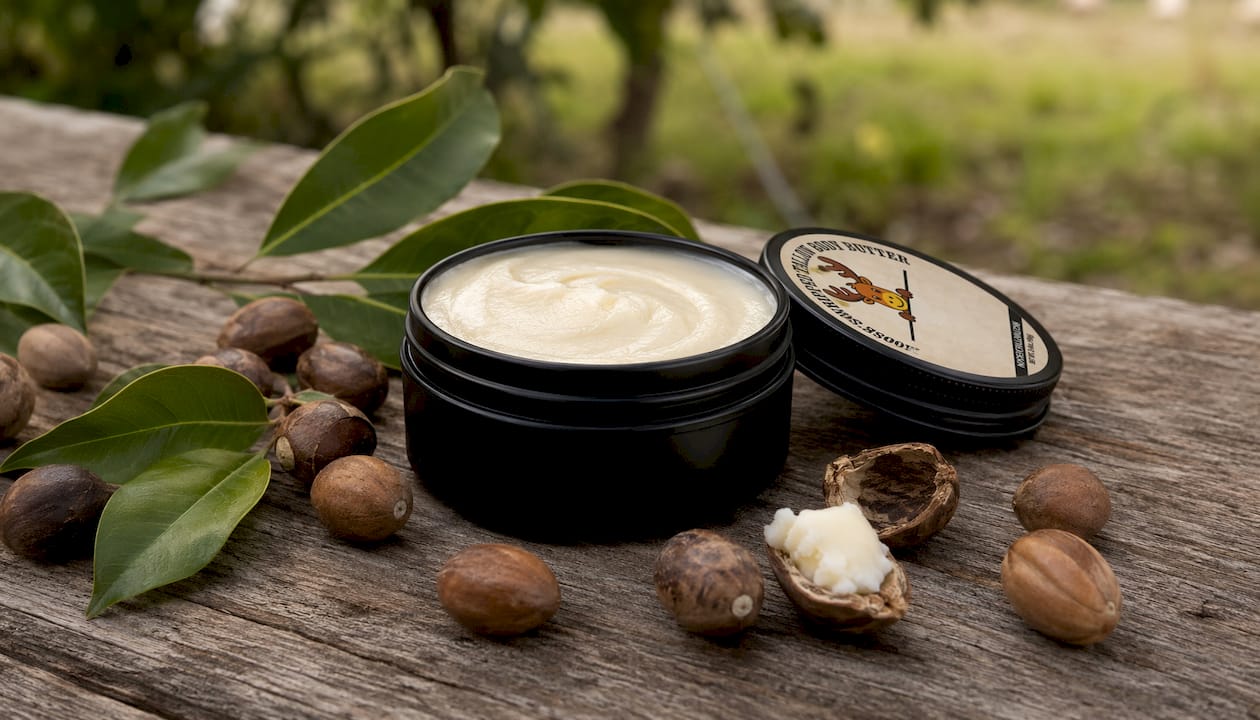
Shea butter comes from the nut of the African shea tree (Vitellaria paradoxa). The nuts are cracked, roasted, ground, and boiled or cold-pressed to extract the fat. Unrefined shea is ivory to yellow and carries a faint nutty scent. Refined shea is white and odorless but loses some of its natural phytosterols in processing.
The origin difference matters beyond ethics:
- Tallow is an animal byproduct. It is not vegan.
- Shea butter is plant-derived and vegan-friendly.
- Processing quality affects both: poorly rendered tallow smells rancid; over-refined shea loses beneficial compounds.
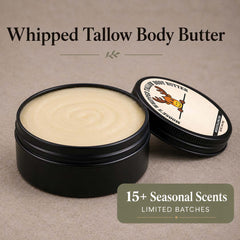
At Moose’s Tallow, the tallow used in every product, from the Whipped Tallow Body Butter to the Natural Tallow Baby Butter with Calendula & Chamomile, is locally sourced, grass-fed beef suet, rendered in small batches in Lebanon, PA. No shortcuts.
How the fatty-acid makeup differs and why it matters for your skin
This is where the tallow vs shea butter comparison gets concrete. Both fats are dominated by three fatty acids: oleic, palmitic, and stearic. The ratios are what set them apart.
- Tallow: Higher in palmitic acid (a key component of human sebum) and oleic acid. Lower in stearic acid. This balance mirrors human sebum more closely than most plant fats.
- Shea butter: Higher in stearic acid, which gives it a firm, waxy structure. Oleic acid is present (roughly 40–50% per GC-MS analysis), but the dominant stearic content pushes shea toward occlusion rather than integration.
- Linoleic acid: Shea contains some; tallow contains very little. Linoleic is associated with barrier repair in compromised skin.
Why does this matter practically? Palmitic and oleic acids allow tallow to integrate more smoothly into the stratum corneum, the outermost skin layer. Shea’s high stearic content means it sits more on the surface and acts as a physical barrier rather than blending into the skin’s lipid matrix.
One honest caveat: most of the literature compares fatty-acid profiles in isolation, not whole-fat clinical outcomes on real skin. Neither fat is a proven treatment for any skin condition. Both are best described as barrier-supportive emollients. The formula around the fat, the carrier oils, the water content, the dilution, matters as much as the fat itself.
How tallow and shea feel and absorb on face, body, and beard
Sensory behavior is where most people make their final call.
Tallow tends to warm and soften on contact with skin. It absorbs without leaving a heavy film. On the face, a small amount goes a long way. On the beard, it conditions without weighing hair down. For facial and grooming use, absorption and sebum similarity often matter more than raw occlusive power.
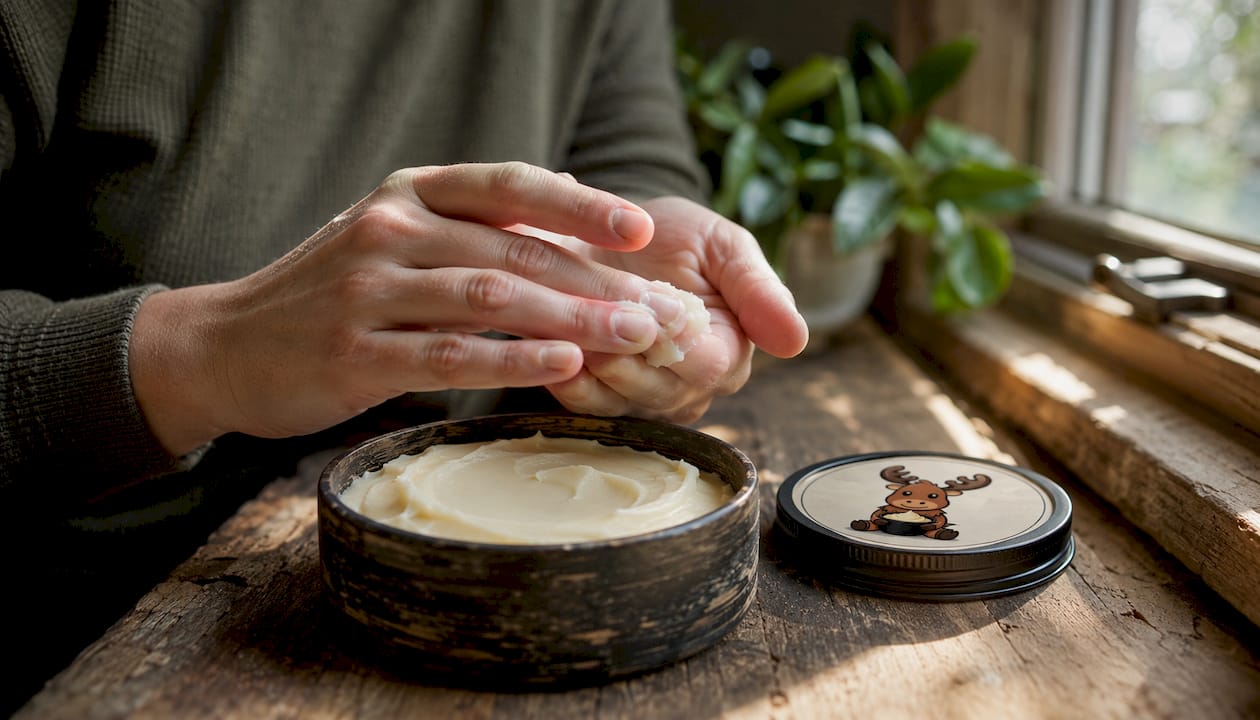
Shea butter is firmer at room temperature. It takes more working between the palms to soften. On the body, that firmness is useful: it creates a durable moisture seal on rough elbows, knees, and heels. On the face, many people find it too heavy for daily use, and it can leave a visible residue.
A few practical notes:
- Scent: Properly rendered tallow has a very mild, neutral scent. Unrefined shea has a distinct nutty smell some people love and others dislike.
- Greasiness: Both can feel greasy if over-applied. A pea-sized amount of tallow is usually enough for the face.
- Layering: Tallow pairs well with fractionated coconut oil for a lighter, faster-absorbing blend. Shea can be softened with the same carrier but remains heavier.
- Temperature sensitivity: Shea gets very hard in cold weather and very soft in heat. Tallow is more stable across temperatures.
Which fat works best for your skin type?
Short answer: it depends on your skin goal and your tolerance for animal-derived ingredients. Here is a practical breakdown.
| Skin type | Tallow | Shea butter |
|---|---|---|
| Dry, flaky | Absorbs cleanly; supports barrier | Strong occlusion; good for very dry body skin |
| Very dry / cracked | Excellent for face and body | Works well on thick, cracked areas |
| Oily / combination | Use sparingly; patch-test first | Heavier; higher risk of residue |
| Acne-prone | Patch-test; oleic content is a variable | Patch-test; stearic content may be better tolerated |
| Sensitive / reactive | Generally well-tolerated; minimal ingredients | Check for shea nut allergy first |
| Aging skin | Sebum-like profile supports barrier | Occlusive; good for dry, aging body skin |
| Men (face, beard, shaving) | Preferred for absorption and grooming | Heavier; less practical for daily facial use |
Men specifically: Tallow absorbs fast and does not leave a shine. It works under a beard, as a post-shave balm, and as a daily face moisturizer without feeling like a product. Shea butter tends to sit on top, which most men find uncomfortable for facial use.
Clogging risk and acne: practical notes and how to test
Comedogenicity ratings are a useful starting point, not a verdict. Oleic-heavy oils tend to score higher on comedogenic scales, which flags tallow for some acne-prone skin. But individual response varies widely. A rating of 2 or 3 on a scale of 5 does not mean everyone breaks out.
Shea butter’s higher stearic content is sometimes cited as less likely to clog pores. That may hold for some people. It does not hold for everyone.
Pro Tip: Start with a patch test on your inner arm for 48–72 hours before applying any new fat to your face. If no reaction, try a small amount on the jawline or neck for a week before committing to full facial use.
Here is a simple test routine:
- Apply a small amount (pea-sized) to the inner forearm.
- Wait 48–72 hours and check for redness, bumps, or irritation.
- If clear, apply a thin layer to the jawline or neck only.
- Use once daily for 5–7 days and observe.
- If no breakouts or congestion, expand to full face use.
- If you notice clogging, try diluting with fractionated coconut oil or switch to body-only use.
Sourcing, sustainability, and the ethical trade-offs to weigh
Neither fat is automatically the “green” choice. The answer depends on sourcing context.
Tallow is a byproduct of beef production. When sourced from regenerative or local farms, it can function as a circular ingredient: fat that would otherwise be discarded gets a second use in skincare. That framing changes the lifecycle math considerably compared to a dedicated crop grown for cosmetic use.
Shea butter comes with its own trade-offs. Shea trees grow wild across sub-Saharan Africa and support local economies. But global demand has increased pressure on supply chains, and some commercial shea involves long-distance shipping and heavy refining. Plant-based does not automatically mean lower impact.
What to look for when buying either:
- Tallow: Local sourcing, small-batch rendering, grass-fed or regenerative farm origin, ingredient transparency.
- Shea: Unrefined or minimally processed, fair-trade sourcing, short supply chain where possible.
A few other considerations worth naming: tallow is not suitable for vegans, vegetarians, or those with religious dietary restrictions around beef (including some Hindu and Muslim consumers). Shea is plant-derived but comes from a nut, which raises allergy considerations for a small group of people.
Shea also contains phytosterols and antioxidants that tallow lacks. Marketers use this point to favor plant oils. It is a real difference, though the clinical significance for topical use is not firmly established.
Practical how-to: applying and blending tallow or shea in your routine
Getting the most from either fat comes down to application technique and what you pair it with.
For tallow balm on the face:
- Warm a pea-sized amount between your fingertips for 10–15 seconds.
- Press gently into clean, slightly damp skin.
- Let it absorb for 60 seconds before applying anything else.
For body use: A slightly larger amount, warmed in the palms, works well on rough patches. Apply after a shower while skin is still warm.
Pro Tip: Fractionated coconut oil is the preferred carrier for tallow-based blends. It is stable, resists oxidation, absorbs easily, and extends shelf life without changing the feel of the base fat. A simple 70/30 tallow-to-fractionated-coconut-oil blend gives a lighter texture that works well for daily face use.
A few formulation notes:
- A small amount of beeswax adds structure and helps a balm hold its shape without making it greasy.
- Vitamin E (tocopherols) extends shelf life and supports the skin barrier.
- Water-free formulas last longer and deliver more active fat per application. No water means no dilution.
- For shaving or beard use, warm tallow between your palms and apply to a damp beard or freshly washed face. It conditions without clogging the razor.
- Avoid mixing either fat directly with water-based actives like vitamin C serums. Apply tallow or shea as the last step, over water-based layers.
For a deeper look at applying tallow skincare, the Moose’s Tallow blog covers the full routine.
Decision checklist: five steps to pick tallow or shea for your routine
Follow these five steps and you will have a clear answer.
- Identify your skin goal. Barrier support and fast absorption? Tallow. Heavy occlusion for very dry body skin? Either fat works, though tallow still absorbs more cleanly.
- Check your ingredient preferences. Vegan or vegetarian? Shea is the plant-derived option. Open to animal-derived? Tallow’s sebum-like profile is the stronger pick for most skin goals.
- Test texture preference. Apply a small amount of each to your inner arm on separate days. Notice which one absorbs faster and feels more comfortable.
- Patch-test for tolerance. Follow the six-step patch-test routine above before committing to facial use with either fat.
- Choose a formulation with intentional carrier oils. Look for fractionated coconut oil as the carrier, minimal dilution, and no water as the first ingredient. A water-free formula delivers more fat per application and lasts longer on the shelf.
If sebum-like support is your goal and you are open to animal-derived ingredients, tallow wins on absorption and compatibility. Shea is a legitimate plant-based contrast, not a superior alternative.
How Moose’s Tallow renders and formulates tallow differently
Brian Smith started Moose’s Tallow in Lebanon, PA, after reading the label on a popular lotion. It listed 52 ingredients. The first was water. He wanted something simpler and real.
Every Moose’s Tallow product is built on properly rendered, locally sourced, grass-fed beef suet tallow. The rendering happens in small batches. The formulation palette is intentional and short:
- Beef suet tallow: the base, always
- Fractionated coconut oil: preferred carrier for stability, oxidation resistance, and absorption
- Beeswax: structure and texture
- Vitamin E (tocopherols): shelf life and barrier support
- Jojoba, castor, egg yolk infused oil: added where they serve a specific purpose
Three products show this approach in practice. The Whipped Tallow Body Butter is the everyday workhorse: water-free, lightly whipped, and built for face and body. The Natural Tallow Baby Butter with Calendula & Chamomile uses the same tallow base with gentle botanicals for sensitive baby skin. The Coconut After Sun Body Butter adds fractionated coconut oil for a lighter, fast-absorbing texture suited to sun-exposed skin.
Every order comes with a 60-day guarantee. Ingredient lists are published in full. No hidden fillers, no water padding the formula.
What to expect on price and value when buying tallow or shea products
Price varies more by formulation quality than by ingredient. A jar of raw, unrefined shea butter is inexpensive. A well-formulated, small-batch tallow balm with fractionated coconut oil, beeswax, and vitamin E costs more, and for good reason.
Key price drivers to understand:
- Sourcing: Grass-fed, locally rendered tallow costs more than commodity beef fat. Fair-trade, unrefined shea costs more than refined bulk shea.
- Water-free formulation: A water-free product delivers more active ingredient per ounce than a water-first lotion. You use less per application.
- Small-batch production: Handmade, small-batch products carry higher labor costs but better quality control.
- Added actives: Botanicals like calendula and chamomile, or functional oils like jojoba and castor, add cost and value.
Moose’s Tallow products run $9 to $34. That range reflects the formulation, not padding. When comparing prices, check the ingredient list first. If water is the first ingredient, you are paying for water.
Quick buying tips: Look for “water-free” or “anhydrous” on the label. Compare per-ounce cost, not jar size. Small-batch signals (handmade, local rendering, short ingredient list) are worth paying for.
Allergy, safety, and practical patch-test steps
Shea nut allergy is real but uncommon. Shea butter is derived from the nut of the shea tree. People with tree nut allergies should consult a healthcare provider before using shea-containing products. Cross-reactivity is possible, though shea nut allergy is considered low-risk by most dermatology references.
Tallow is generally well-tolerated by most skin types. It is animal-derived, which is a consideration for vegans, some religious groups, and anyone with a sensitivity to bovine products.
Regulatory note: Both tallow and shea butter are used in cosmetic products only. Neither is a drug, and neither treats, cures, or prevents any skin condition. For any diagnosed skin condition, consult a dermatologist.
Key Takeaways
Tallow’s sebum-like fatty-acid profile makes it the stronger pick for barrier support and clean absorption; shea butter is a legitimate plant-based occlusive but does not match skin’s own lipid chemistry as closely.
| Point | Details |
|---|---|
| Tallow mirrors sebum | Palmitic and oleic acids in tallow closely match human sebum, supporting cleaner absorption. |
| Shea is a strong occlusive | High stearic acid makes shea effective for surface moisture-sealing, especially on the body. |
| Skin type matters | Dry and aging skin benefit from either; oily and acne-prone skin should patch-test both carefully. |
| Fractionated coconut oil | Use it as your carrier for stability, oxidation resistance, and faster absorption in any blend. |
| Moose’s Tallow approach | Water-free, small-batch tallow products built on beef suet tallow and fractionated coconut oil, backed by a 60-day guarantee. |
Why tallow is still the honest answer for most skin goals
Most of the current tallow conversation is driven by social media, not large clinical trials. That is worth saying plainly. But the fatty-acid argument for tallow is not hype. It is basic ingredient chemistry: a fat that resembles your skin’s own oils tends to absorb more cleanly than one that does not.
Shea butter is a genuinely useful ingredient. It has real occlusive strength, and in-vitro research shows it can reduce transepidermal water loss meaningfully. But “occlusive” and “sebum-like” are not the same job. For daily facial use, for beard care, for post-shave recovery, absorption and compatibility matter more than raw sealing power.
The part most comparison articles skip: the formula around the fat matters as much as the fat itself. A tallow product diluted with water and loaded with synthetic emulsifiers is not delivering what the ingredient promises. A water-free tallow balm with fractionated coconut oil and nothing to hide is a different product entirely. That gap is exactly why ingredient transparency is worth demanding, not just appreciating.
Moose’s Tallow makes the tallow vs shea choice simple
Dry skin, sensitive skin, post-sun skin, or baby skin: Moose’s Tallow has a water-free, small-batch formula built for it. The Whipped Tallow Body Butter is the everyday starting point for sebum-like daily support on face and body. For gentle care on sensitive or baby skin, the Natural Tallow Baby Butter with Calendula & Chamomile uses the same tallow base with calming botanicals. After a day in the sun, the Coconut After Sun Body Butter delivers fast-absorbing tallow with fractionated coconut oil to rehydrate without heaviness.
Every product ships across the US, lists every ingredient in full, and comes with a 60-day guarantee. No fillers, no water padding, no guessing what is in the jar. Browse the full lineup and find the right fit for your skin.
Useful sources
- Tallow vs Shea Butter: How the Two Fats Actually Compare: A detailed ingredient-level comparison covering fatty-acid profiles, occlusion, and absorption behavior.
- Beef Tallow in Skincare: Sebum-Compatible Lipid Profile, Mechanism, and Evidence: Covers the sebum-similarity argument and how tallow integrates into the stratum corneum.
- Rethinking Sustainability in Skincare: A Comparative Analysis of Beef Tallow and Plant-Based Oils: Lifecycle and ethical analysis of tallow vs plant oils, including land use and upcycling framing.
- PMC: Cosmetic Science and Skin Barrier Research: Peer-reviewed context on barrier mechanics and fatty-acid function in cosmetic science.
- Moose’s Tallow: Tallow vs Plant-Based Moisturizers: Brand resource comparing tallow to plant-based alternatives with formulation context.
FAQ
What’s better for your skin, shea butter or beef tallow?
For sebum-like absorption and skin-barrier support, beef tallow is the stronger pick for most people open to animal-derived ingredients. Shea butter is a solid plant-based occlusive but does not match skin’s own lipid profile as closely as tallow does.
Does tallow really help with wrinkles?
Tallow supports the skin barrier and delivers fatty acids similar to those in human sebum, which can help skin feel smoother and more supple. It is not a treatment for wrinkles, and no cosmetic ingredient can reverse aging.
What is the best butter for aging skin?
For aging skin that is dry and losing barrier function, tallow’s sebum-like fatty-acid profile tends to absorb more cleanly and support the barrier more directly than shea. Shea works well as a body occlusive for very dry, aging skin.
Is shea butter better for certain skin tones or skin types?
Shea butter has deep roots in traditional African skincare and is widely used across skin tones for its moisturizing and occlusive properties. It works well for dry and very dry skin regardless of skin tone. Tallow is equally effective across skin types and tones; the choice comes down to ingredient preference and absorption goals, not complexion.


0 comments