

TL;DR:
- Using fewer well-chosen ingredients in skincare reduces irritation, supports the skin barrier, and simplifies product understanding.
- Science, regulation, and nutrition all support the benefits of minimal formulas, especially for sensitive skin.
More ingredients on a label does not mean a better product. That assumption has shaped cosmetic marketing for decades, and it has quietly worked against skin health for just as long. Understanding why minimal ingredients matter is the clearest way to make smarter choices about what you put on your body. Fewer, well-chosen ingredients reduce irritation risk, support your skin barrier, and make it far easier to know what is actually doing the work. This article covers what the science says, what nutrition tells us, and how to apply the minimal ingredient approach practically every day.
Key takeaways
| Point | Details |
|---|---|
| Fewer ingredients reduce irritation | Limiting ingredient exposure lowers your chances of triggering allergic reactions or skin sensitivity. |
| Every ingredient should earn its place | High-performing, stable ingredients like beef suet tallow and fractionated coconut oil outperform filler-heavy formulas. |
| Minimal does not mean incomplete | Effective routines can include treatment actives while staying simple and gentle. |
| Nutrition and skincare share the same logic | Just as whole foods outperform ultra-processed ones, clean ingredient skincare outperforms bloated formulas. |
| Transparency builds trust | Short ingredient lists are easier to verify, compare, and trust over time. |
Why minimal ingredients matter in skincare
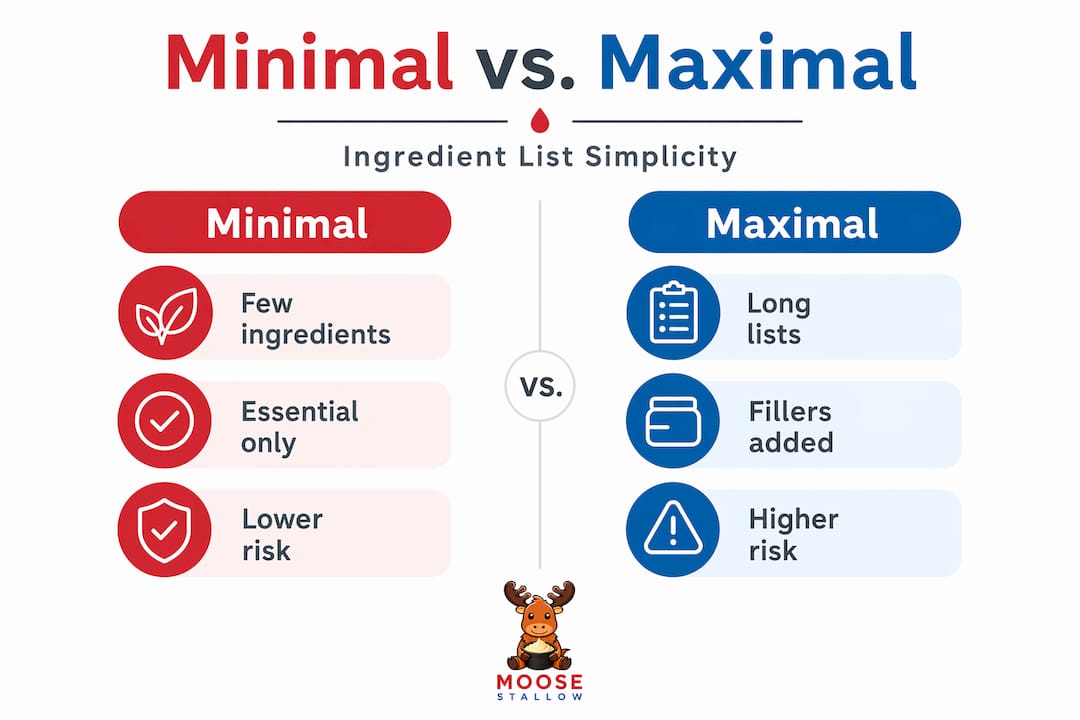
Minimal ingredients means every component in a product has a clear, specific reason for being there. No fillers, no trendy additives included for label appeal alone. In skincare, this translates to formulas built around a short list of high-performance ingredients that genuinely support the skin.
The benefits of few ingredients start with reduced exposure. Every additional ingredient is another variable your skin has to respond to. For people with sensitive or acne-prone skin, that list of variables can be the difference between comfort and a flare-up.
At Moosestallow, the core ingredient list reads short and intentional:
- Beef suet tallow is the foundation. It is biologically compatible with human skin lipids and absorbs well without clogging pores.
- Fractionated coconut oil provides excellent carrier stability, resists oxidation, and absorbs cleanly.
- Beeswax supports barrier function and provides a light protective layer.
- Tocopherols (vitamin E) protect against oxidative stress in the formula and on skin.
- Jojoba closely mimics natural sebum and supports moisture balance.
- Castor oil adds slip and thickness without destabilizing the formula.
- Egg yolk infused oil brings natural fatty acids and fat-soluble vitamins directly to skin.
Each ingredient above serves a purpose. None are there to pad an ingredient deck.
Pro Tip: When reading a product label, scan for the first five ingredients. Those make up the majority of the formula. If fillers or water appear first, the active ingredients you paid for are likely diluted.
Regulatory and scientific backing
The regulatory environment around cosmetics is getting stricter. The FDA’s Modernization of Cosmetics Regulation Act, known as MoCRA, has increased oversight of cosmetic safety and mandatory recall criteria. That shift matters because it reinforces what minimal ingredient advocates have argued for years: claims about a product need to be substantiated, and simpler formulas are easier to evaluate for safety.
From a dermatology standpoint, the logic is equally clear. Simple acne routines using gentle, fragrance-free products are considered more effective for sensitive skin than complex, multi-step regimens. The Mayo Clinic’s guidance follows a four-step approach: cleanse, treat, moisturize, protect. That is it. The fewer the variables, the easier it is to identify what is helping or what is causing a problem.
Here is why a minimal approach makes it easier to manage your skin:
- Isolate reactions. Fewer ingredients make it easier to pinpoint what caused a breakout or irritation.
- Reduce cumulative exposure. Using multiple products with long ingredient lists adds up fast.
- Support your barrier. Stable carriers like fractionated coconut oil absorb without disrupting the skin’s natural lipid layer.
- Verify claims. A short ingredient list is easier to research and fact-check than a 30-item deck.
“The importance of minimal ingredients in skincare is not about restriction. It is about clarity. When you know exactly what is in your product, you can make an informed choice.”
Fractionated coconut oil is worth calling out specifically. Unlike many carrier oils, it does not go rancid, absorbs quickly, and does not introduce unnecessary fatty acid variability. That stability translates directly to formula integrity and skin compatibility over time.
What nutrition tells us about ingredient simplicity
The parallels between food and skincare are more direct than most people realize. The NOVA classification system, used widely in nutrition research, distinguishes minimally processed foods from ultra-processed products loaded with additives, emulsifiers, and synthetic colors. The research consistently connects high ultra-processed food intake with poorer health outcomes.

The same pattern appears in skincare. Long ingredient lists in cosmetics often include synthetic stabilizers, artificial fragrances, and cheap fillers that serve the formula’s shelf life or texture, not your skin.
Here is a direct comparison:
| Approach | Food | Skincare |
|---|---|---|
| Minimal ingredients | Whole foods with identifiable components | Short-list formulas using functional ingredients |
| Ultra-processed equivalent | Additives, synthetic flavors, emulsifiers | Synthetic fragrances, PEGs, fillers, cheap carriers |
| Health outcome | Lower metabolic burden, clearer appetite signals | Reduced irritation, stronger barrier, cleaner absorption |
| Trust factor | You know what you are eating | You know what you are applying |
Simplified meals reduce metabolic burden and cognitive load. The same principle holds for skincare. Fewer, well-matched ingredients give your skin less to process and more of what it actually needs.
Pro Tip: Think of your skincare routine the same way you think about eating well. You do not need 20 supplements. You need the right few things, consistently.
Applying a minimal ingredient approach every day
Understanding why fewer ingredients are better is one thing. Putting it into practice is where it counts. Here is how to apply the minimal ingredient philosophy when choosing and using products:
- Read ingredient lists from the top down. Ingredients are listed by concentration. The first five to seven tell you most of what you need to know.
- Ask what each ingredient does. If you cannot find a clear function for an ingredient, it is likely a filler.
- Avoid common irritants. Artificial fragrance, alcohol, and certain synthetic preservatives are among the most frequent triggers for sensitive skin.
- Stick with stable carriers. Fractionated coconut oil is preferred over oils with shorter shelf lives because it resists oxidation and stays effective longer. Oils prone to rapid rancidity can cause more irritation than they resolve.
- Simplify your routine. More products do not mean more benefit. A clean cleanser, a purposeful moisturizer, and sun protection will outperform a 10-step routine built on fillers.
- Monitor your skin one change at a time. When you try a new product, introduce it alone. That is the only way to know what is working.
Moosestallow’s approach to ingredient simplicity reflects this logic. Tallow is always the star, backed by a small team of functional, verified ingredients. Nothing is there by accident.
Common myths about minimal ingredients
Minimal ingredients gets misunderstood regularly. Here are the most common misconceptions, set straight:
- “Minimal means no actives.” Not true. Treatment ingredients like low-dose benzoyl peroxide or salicylic acid fit within a minimal approach. The key is intentionality and appropriate dosing, not ingredient avoidance.
- “Fewer ingredients means less effective.” Effectiveness is about function, not quantity. Beef suet tallow delivers fatty acids, vitamins, and lipids in one ingredient. That is more efficient than six synthetic components trying to replicate the same effect.
- “All minimal-ingredient products are the same.” Ingredient quality and sourcing matter as much as quantity. A product with three cheap, poorly sourced ingredients is not better than a seven-ingredient formula with proven, stable components.
- “The ‘natural’ label guarantees safety.” Minimal and natural are related but not identical. The nuanced debate around ultra-processed food definitions applies here too. Context, dosing, and sourcing matter more than a single label claim.
The simple ingredients benefits are real. But they work best when you understand what minimal actually means.
My honest take on why this matters
I have seen the same pattern repeat with people who come to Moosestallow after years of trying complicated routines. They have used products with 30 or 40 ingredients, chased every new active, and still dealt with dryness, sensitivity, or breakouts.
When they switch to something simple and intentional, their skin often settles down within weeks. Not because tallow is magic. Because their skin finally got a break from the constant barrage of unfamiliar compounds.
What I have learned is that the best thing you can do for reactive skin is reduce the noise. The natural moisturizer benefits from a well-formulated, minimal product are not dramatic. They are steady. That steadiness is what good skin health actually looks like.
I also think there is something honest about a short ingredient list. It says: we know what is in this, we chose it deliberately, and we stand behind it.
— Brian
Discover Moosestallow’s minimal ingredient approach
At Moosestallow, every product starts with properly rendered beef suet tallow and builds from there. Each formula uses a small number of carefully chosen ingredients, including fractionated coconut oil, beeswax, tocopherols, jojoba, and castor oil. Nothing is included without a reason. No synthetic fillers. No artificial fragrance. No padding. If you are ready to simplify your routine and use products you can actually trust, explore the full Moosestallow product range and see what honest, minimal skincare feels like.
FAQ
What does minimal ingredients mean in skincare?
Minimal ingredients means every component in a product has a specific, functional reason for being there. No fillers, no synthetic additives included for texture or fragrance appeal without benefit.
Why are fewer ingredients better for sensitive skin?
Fewer ingredient products reduce the number of potential irritants your skin is exposed to, making it easier to maintain a stable barrier and identify any triggers when reactions occur.
Can minimal ingredient products still treat skin concerns?
Yes. Minimal routines can include treatment actives at appropriate doses. The goal is intentional selection, not avoidance of every active ingredient.
How do I know if a product uses fillers?
Check the first five ingredients on the label. If water, glycerin, or synthetic stabilizers dominate the list before any functional ingredient, the formula is likely diluted with low-value additions.
Is the minimal ingredient approach supported by science?
Yes. Dermatology guidance from sources like the Mayo Clinic favors simplified skincare routines for reducing irritation and improving outcomes, particularly for sensitive and acne-prone skin.


0 comments